How to Run a Duck Race Fundraiser: A Step-by-Step Guide
What a rubber duck race is and how to run one: set the goal, pick the water, line up sponsors, build teams, promote, and make race day an event.
A duck race is one of the most joyful fundraisers your organization can run: supporters buy numbered rubber ducks (we call it adopting), the whole flock races down the water, and the duck that crosses first wins a prize. Behind the fun is a remarkably reliable fundraising engine, one that’s raised over $280M for more than 2,000 organizations since 1988.
Here’s how a great one comes together.
What is a rubber duck race?
A rubber duck race (also called a duck derby) is a fundraiser where supporters adopt numbered rubber ducks, usually for $5 each, and every adopted duck races down a stretch of water toward a finish line. The first ducks across win prizes for the people who adopted them, and the adoption money funds your cause.
It works because it breaks away from the same old asks. Nobody has to buy a gala ticket, a tee time, or a tub of cookie dough, and it takes no skill to play. A neighbor who has never heard of your organization can buy a few ducks in a minute, a grandparent can buy one for every grandkid, and your message reaches well past your usual donor list.
1. Set a goal you can rally around
Start with a number that means something to your community. A clear, concrete goal, “$25,000 to fund a new playground,” converts far better than a vague “help us raise money.” It gives supporters a reason to share and a finish line to cheer toward.
Work backward from the goal to a duck target. At $5 a duck, $25,000 means 5,000 ducks. That’s your North Star for the whole campaign.
2. Pick your date and your water
No river? No problem. Duck races run in rivers, lakes, pools, and even custom water tracks built for the day, and our guide to what kind of water you need covers courses, currents, and what to do with still water. When choosing a date:
- Start planning four to six months ahead for a first race. Here’s how far in advance to plan, week by week.
- Aim for good weather and a time families are free (weekend late-mornings are ideal).
- Tie it to an existing community event if you can, and you inherit the crowd.
- Give yourself 6 to 8 weeks of promotion runway before race day.
3. Line up sponsors first
Sponsorship is the most important piece of a duck race. Local businesses that cover your race costs up front mean the event is funded before the first duck is adopted, and every adoption after that goes toward your goal. Build tiers with real perks (logo on the race site, signs at the finish, a named prize) and make the asks early, before your print materials go final.
4. Build your branded race page
Most adoptions happen online, so your race page does the heavy lifting. It should make adopting a duck take less than a minute, work on a phone, show your goal and progress, and look unmistakably like your cause.
The easiest fundraisers to share are the ones that explain themselves in a single screen. If a supporter can understand it, trust it, and adopt a duck without scrolling for answers, you’ve already won.
5. Recruit “duck wranglers” to multiply your reach
The single biggest predictor of a successful race is the number of people asking on your behalf. Recruit board members, volunteers, and local businesses to each captain a team and share their personal link. In our data, races with more than 10 teams sold 2.3x more ducks. A dozen motivated wranglers will outperform any amount of paid promotion. Build teams from the groups you already have: every grade or classroom, every player on the roster, every committee, every table captain from your gala. That way nobody sells alone.
You’ll also want volunteers for adoption tables, the tagging party about a week before the race, and race day itself. Here’s what the host does, job by job.
6. Promote with a simple rhythm
You don’t need a complicated marketing plan, you need consistency:
- Announce the race and the goal.
- Tell stories about what the money will do.
- Share milestones (“We’re halfway to 5,000 ducks!”).
- Create urgency in the final week (“Last chance to adopt before Saturday”).
Pitch your local paper, TV, and radio too. News coverage gives the race credibility and reaches people your social posts never will, without costing you an ad budget.
7. Make race day an event
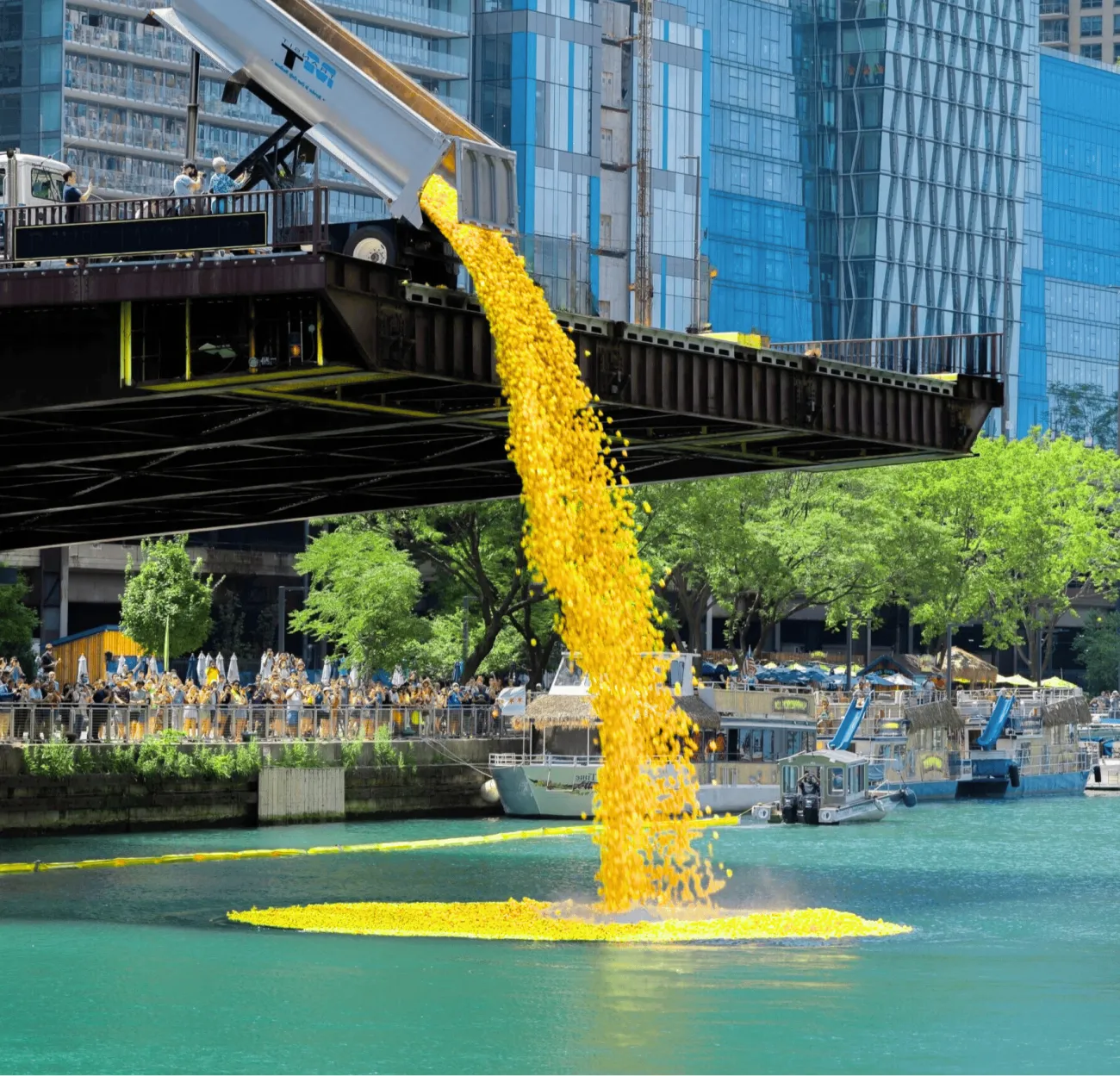
Race day is your thank-you to the community, and your team runs it. Add food, music, and a countdown to the duck dump. The drop is the moment everyone films, so think about who does it: some hosts ask their fire department, and others let a local equipment company sponsor the drop with a front loader or an excavator. Here’s how the ducks get in and out of the water. Announce the winners live, celebrate the total raised, and capture photos and video, which become next year’s best promotion.
You don’t have to do it alone
We bring the ducks and freight both ways, the race website and checkout, managed ads, and a full print kit, so your team can focus on the parts only you can do: rallying your community, landing sponsors, and running a great race day. If you’re weighing a duck race for your organization, we’ll put together a free, no-obligation plan tailored to your goal.