Duck Race vs. Carnival: Which Community Event Raises More?
A straight comparison of duck races and school carnivals: what each costs, when the money arrives, weather risk, and why the two work well together.
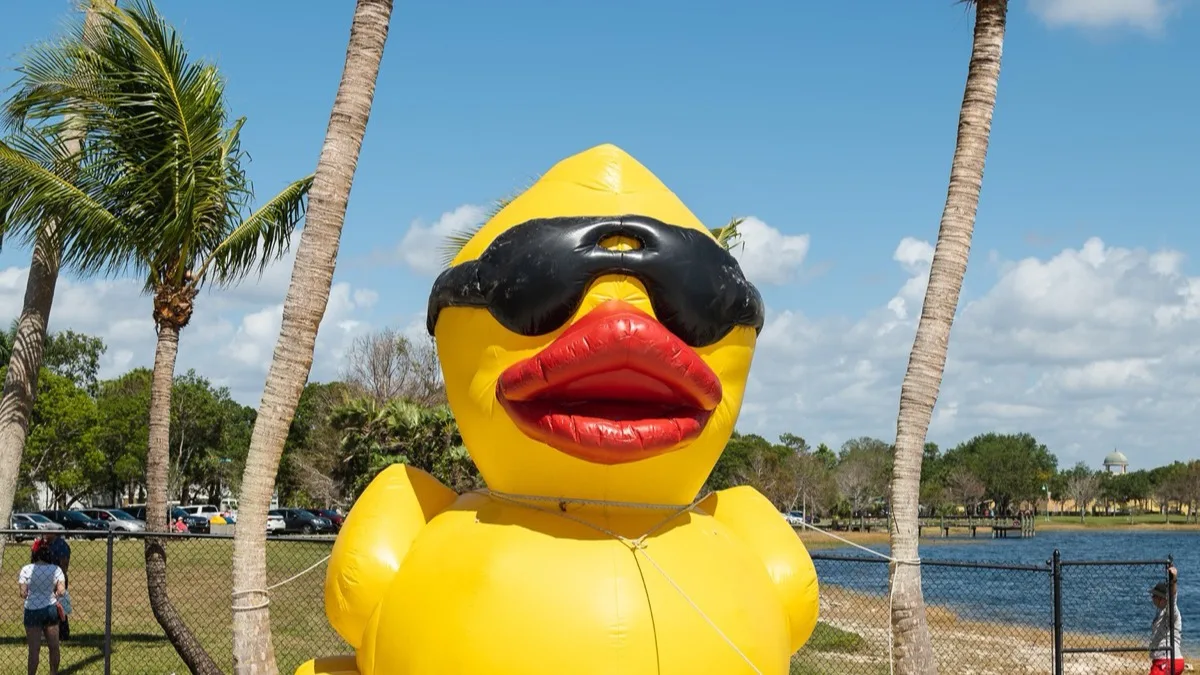
Fall festivals and school carnivals are the default community fundraiser in a lot of towns, for good reasons. They’re also one of the hardest formats to clear real money on, and the reason is structural rather than any failure of effort.
Duck races usually out-earn carnivals because the money comes in before the event happens. A well-run carnival grossing $8,000 nets roughly $3,500 to $4,000 after rides, food, and prizes, and a rained-out Saturday can zero it. Duck adoptions sell online in advance at $5 each, and our race platform’s 2025 average adoption was $50 per supporter, so about 500 people gross $25,000, netting roughly $16,000 after a flat package starting under $9,000.
Why does a carnival struggle to clear real money?
Almost everything a carnival sells has to be bought first.
The list runs longer than most committees expect, and all of it lands before a single family walks through the gate:
- Rides and inflatables. Rentals typically run a few hundred dollars per unit, and a full midway from a carnival vendor climbs well into the thousands.
- Food. Whatever you charge for a hot dog, you already paid for the hot dog, the bun, the foil, and the propane. Cost of goods commonly eats 30 to 40 cents of every dollar across the window.
- Prizes. Inventory, ordered in bulk, and whatever nobody wins lives in a closet until next year.
- Wristbands and signage. Printing, ordered for the crowd you hope shows up rather than the one that does.
- Permits and insurance. Plenty of towns want both before you set out a single cone.
Every one of those is spent whether 400 families come or 90 do.
Run the arithmetic on a good day, and swap in your own numbers as you go. Two hundred families through the gate. Forty dollars each across wristbands, food, and game tickets. That’s $8,000 gross, which sounds like a real number right up until you subtract $2,000 of inflatable rental, roughly $2,000 of food you had to buy before you could sell it, and a few hundred in prize inventory. A well-run carnival with strong turnout lands somewhere around $3,500 to $4,000 net.
Here’s the same community as a duck race. Two hundred supporters at the 2025 average adoption of $50 is $10,000, with no cost of goods against it, and not one of those 200 people had to stand in a parking lot in October to hand it over. Your one cost is a flat package, which most hosts get local sponsors to cover before adoptions open, and the race isn’t limited to the families who came through the gate.
There’s a quieter second problem. Wristband pricing is sticky. You set it at $20 in 2019, and moving it to $30 now feels like taxing your own families, so the price holds while costs climb and the margin compresses a little every year. The volunteer hours never compress.
Where does the money actually come from?
Carnival money comes from people who are physically present, in small increments, inside a four-hour window. Duck race money comes in ahead of race day, online, from anyone.
That single difference drives everything else in this comparison.
Think about who a carnival can’t collect from. The family with a soccer tournament two counties over. The retired couple down the block who’d write you $50 and have no earthly reason to stand in line for a bounce house. The parent working a double that Saturday. Every one of them would have given you something, and the format has no way to take it.
The duck race collects from all of them. The retired couple adopts ten ducks at their kitchen table and never sets foot on the blacktop. The soccer family adopts from a hotel lobby the night before their tournament. By the time the ducks hit the water, the fundraising is finished and the event itself is a celebration of a number you already know.
How do the two compare side by side?
| School carnival / fall festival | Duck race | |
|---|---|---|
| When you collect | Day of, on site | Weeks in advance, online |
| Typical transaction | $2 to $5 per ticket, game, or plate | $50 average adoption (DDR race platform, 2025) |
| Who can give | People who physically attend | Anyone, anywhere |
| Cost of goods | Real: you buy the food and prizes you sell | None against adoption revenue |
| Upfront spend | Rides, food, prizes, permits, insurance | Flat package cost, known before you commit |
| Volunteer shape | Wide and shallow, all on one morning | Concentrated: sponsor asks, promotion, race day |
| Weather risk | Severe, with no advance revenue as backup | Low, since the money is already banked |
| Sponsorship | Booth signage, usually modest | A primary revenue line |
| Growth curve | Capped by gate attendance | Grows year over year; typical first race is $20,000+ gross |
What happens if it rains?
A carnival loses most of its revenue and a duck race loses almost none, because the duck race was already paid for.
Rain on carnival day means the inflatables are already rented, the food is already bought and mostly perishable, forty volunteers already gave up their morning, and the gate that was supposed to cover all of it never materializes. There’s no advance revenue to fall back on. A rain date helps if the venue can give you one, though you’ll lose families to whatever else lands on that new Saturday.
Rain on race day means the ducks get wet, which is the one thing they’re engineered for. Adoptions closed days earlier. You move the crowd under a pavilion, read the winning numbers, and stream the drop for anybody who stayed home. Some of our partners run theirs as a virtual or hybrid race on purpose, which works because the revenue was never tied to attendance.
How many volunteers does each one really need?
Carnivals need more people, spread thinner, all on the same morning.
Count it instead of estimating from memory. Twenty booths, two volunteers each, two shifts apiece, and you’re recruiting eighty bodies before you’ve staffed setup, teardown, the ticket table, or the person who drives to the store when the ice runs out. Every one of those slots has to fill by 9 a.m. or the booth stays dark.
Duck races concentrate the effort instead of spreading it. Six weeks of sponsor asks, made by four or five people who will follow up on the second call. A promotion push that mostly lives on a phone. Then race day, which needs a crew hauling mesh bags of ducks down to the water, not an army in twenty booths by nine in the morning. If your real constraint is bodies rather than enthusiasm, that shape matters more than the headcount, and it’s worth sketching out your race committee before you compare the two.
When is a carnival the right call?
When you need revenue without selling anything in advance, and when the gathering itself is part of the mission.
Start with the money. A carnival is a platform. It can run six revenue lines off a single afternoon of foot traffic, and a few of those lines carry margins a duck race can’t match.
| Carnival revenue line | Where the money comes from | Margin |
|---|---|---|
| Wristbands or gate | Families paying to get in | Nearly all margin once the rentals are paid |
| Food and drink | Concessions | Roughly 60 to 70 cents on the dollar after cost of goods |
| Game booths | Small per-play tickets | Strong when the prizes are donated |
| Bake sale or treat table | The crowd that’s already standing there | Nearly pure margin, since families donate what they bake |
| Silent auction table | Donated items | Close to pure margin |
| Booth sponsorships | Local businesses | Pure margin, and collected before the gate opens |
Stack enough of those and a festival that nets $4,000 on the gate, food, and games lands meaningfully higher. Concessions are the underrated line. Food scares committees because of the cost of goods, but a hot dog you bought for a dollar and sold for three keeps two of those dollars, which beats what most product fundraisers hand you.
The other advantage is that a carnival asks nobody to commit in advance. No presale, no six-week promotion, no sponsor deck, no refreshing an adoption page in week three to see whether anyone bought. You open the gate and the revenue walks in. For a committee that has watched a ticketed event undersell, that’s a different risk profile.
For three hours on a Saturday, parents stand around with bad coffee while their kids run loose in a place designed for kids to run loose. Kindergarten families meet fifth-grade families. New parents finally figure out who the PTA actually is. Organizations that keep running carnivals at thin margins usually know exactly what they’re buying, and they’re not wrong to buy it.
Two more points in its favor. A festival in year 22 has a constituency, the cake walk has defenders, and cancelling it carries a political cost that’s easy to underestimate. And nobody has to donate to walk in, which at a school where families are stretched is a feature, not a rounding error.
What a carnival can’t do is scale past the gate. That ceiling is the argument.
Should you run the duck race as the festival finale?
If you already have a festival, this is the answer we give more often than any other.
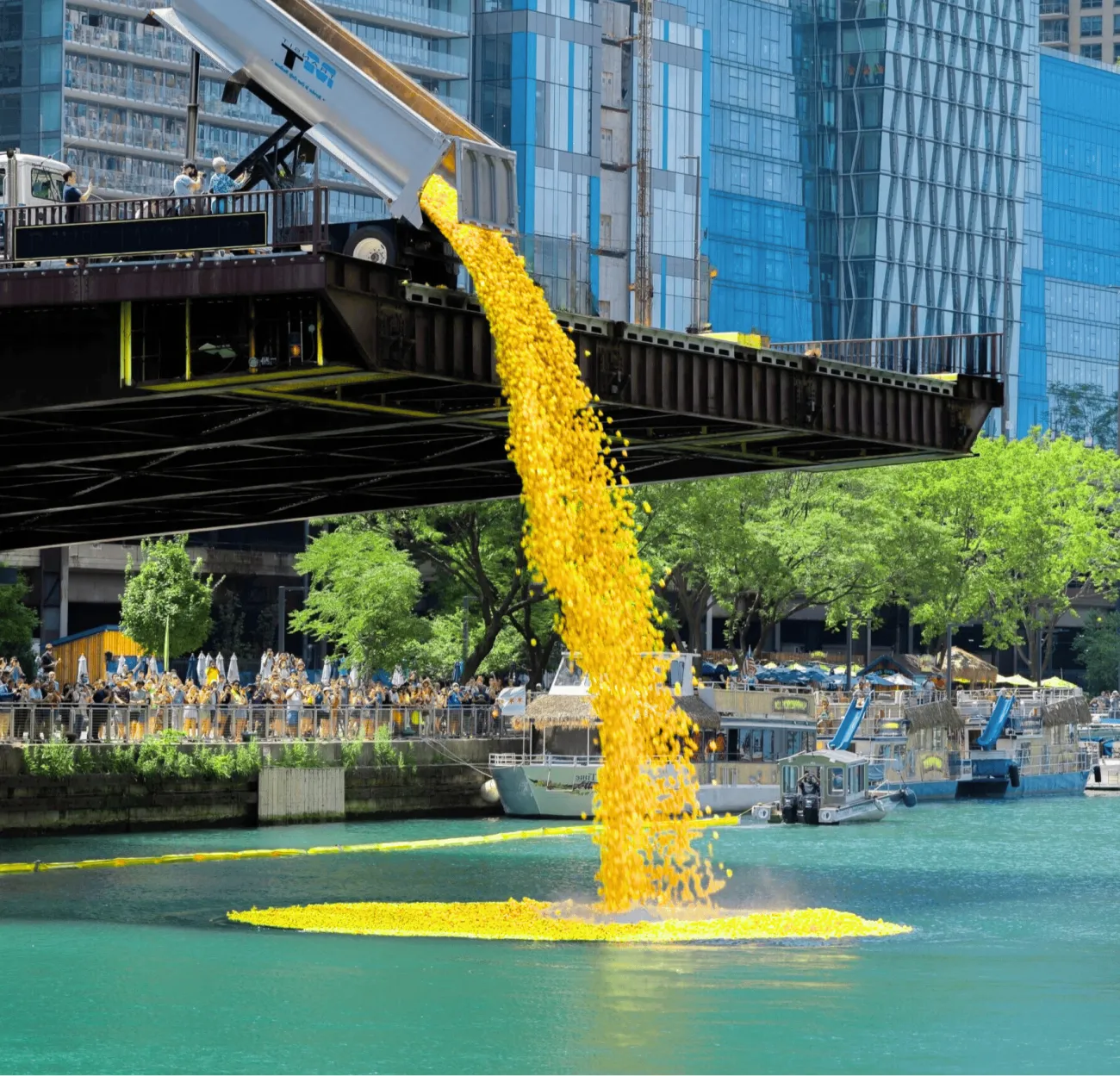
Keep the carnival. Sell duck adoptions online for six weeks leading up to it. Then at 3:00, everyone walks over and watches ten thousand ducks go in the water. Your festival gains a headline moment and a reason for the local news to send a camera. Your duck race inherits a crowd that’s already assembled. And the revenue was banked before the gate opened, so the forecast stops holding your budget hostage.
You don’t need a river for this, either. The raceway is a solvable problem. The crowd is the hard part, and your festival solved that one twenty years ago.
Running both is also the cheapest way to test whether a duck race fits your community, since you’re monetizing an audience you already built. If budget is what’s stopping you, the full cost breakdown is worth reading before your next board meeting.
What are the best alternatives to a school carnival?
The main alternatives to a school carnival are a trivia night or spring auction, a read-a-thon or fun run, a product sale, and a duck race. Price them before you commit to another year of the festival, because they fail in very different places.
A trivia night or spring auction keeps the gathering and swaps the crowd. Instead of 600 people paying $2 a ticket for the ring toss, you get 120 adults paying $40 a head and bidding on things, which is a far better hourly return and a much narrower slice of your school. Some PTAs love that trade. Others find out in March that the families who most need to feel included are the ones who didn’t buy a table.
A read-a-thon or fun run is the quiet workhorse of elementary fundraising. Pledges come in before the event, there’s essentially no cost of goods, and the kids are doing something you’d want them doing anyway. Its weakness is that it asks the same twenty families for money in a slightly different costume every year, and by the third or fourth run you can feel the pledge sheets getting thinner. A product sale is the opposite problem: it launches in a week and hands the vendor 50 to 60 cents of every dollar your kids earn.
Which brings you to the duck race. It presells, and that’s the single thing a carnival structurally can’t do. Money lands in your account six weeks before anybody looks at a forecast, so the weather stops mattering to the budget. That comes with a real package cost before you’ve raised a dime, and it takes four to six months instead of six weeks. All of them sit on the same columns in our fundraiser comparison guide.
Frequently asked questions
How much does a school carnival raise?
Most school carnivals gross in the low four to low five figures and net well under half of it, because the inflatables, the hot dogs, and the prizes all get bought before anyone buys them from you. A carnival grossing $8,000 against $2,000 of ride rental, roughly $2,000 of food cost, and a few hundred in prizes lands near $3,500 to $4,000 net. Sponsor booths, an auction table, or a bake sale push that higher. The gate is still the ceiling.
Can you run a duck race at a fall festival?
Yes, and it’s the setup we recommend most often. Sell adoptions online in the weeks beforehand, then drop the ducks as the closing act of the festival. Revenue is collected in advance, so weather can’t erase it, and the festival gains a headline event local media will film. The two don’t compete for the same dollars.
Do you need a river or a lake for a duck race?
No. Duck races run in swimming pools, water slides, retention ponds, fountains, canals, and streets flooded by a fire department. Derby Duck Races has helped hosts plan raceways since 1988 in plenty of places with no natural waterway nearby. Pick the location that draws the biggest crowd, then work out the course with us. Our guide to duck race water covers the options.
How many ducks do we actually have to sell?
Far fewer people than the duck count suggests. Ducks typically go for $5, and the 2025 average adoption was $50, which is about ten ducks per person. So a 5,000-duck race worth $25,000 needs roughly 500 supporters, and a 10,000-duck race worth $50,000 needs roughly 1,000. Most organizations already have that many names in a contact list.
Keep the festival, add the part that pays for it
A carnival is capped by how many people walk through the gate. A duck race is capped by how many people you can reach, which is a much larger number and one that grows every year you run it. For most organizations with a festival already on the calendar, the smart move isn’t choosing between them at all.
Picture the festival at ten to three. The bounce house has started to sag, the cotton candy machine’s been unplugged for an hour, and somebody’s calling everyone over to the retention pond behind the bus loop. Then ten thousand numbered ducks come off the truck bed at once and hit the water with a sound nobody in that crowd has heard before. A dad who adopted his ten ducks back in March, on his phone, in the pickup line, has a four-year-old on his shoulders and is squinting at a slip of paper, yelling a number he can’t possibly hear anyone answer.