Duck Race vs. Golf Tournament: Which Fundraiser Raises More?
Duck race vs. golf tournament: real costs, the golfer ceiling, sponsor concentration, weather risk, and the organizations that should keep their tournament.

Golf tournaments are the incumbent. When an organization calls us about a duck race, there’s usually a tournament somewhere in the background that has netted a little less every year for four years running.
A golf tournament caps at roughly 100 to 144 golfers no matter how big your community is, so a full field at $175 a head grosses about $25,200 against $15,000 to $30,000 in costs. A duck race has no such ceiling, because adoptions sell online: at Derby Duck Races’ 2025 average of $50 per supporter, 500 people raise $25,000 and 1,000 raise $50,000. Golf still wins when your donor base is corporate foursomes.
What does a golf tournament cost before a single golfer registers?
More than most boards remember between years. Booking a course generally runs $5,000 to $20,000 depending on your market, your date, and whether somebody on your board can get you a member rate. That’s the line item everyone quotes.
The rest of it adds up quietly. Carts and range balls. Lunch at the turn and dinner after. Goodie bags nobody asked for. Tee signs, banners, printed programs, scorecards, prizes, event insurance, a rented sound system, and the beverage cart. A mid-size tournament commonly lands somewhere in the $15,000 to $30,000 range before a single registration comes in.
Two features of that spend matter more than the total.
First, most of it is committed on a contract months in advance. Course agreements routinely carry a deposit and a food-and-beverage minimum. Field 90 golfers instead of 144 and you can still owe for 144 lunches.
Second, it’s front-loaded. You’re spending real money in February to make money in June, which is exactly the position a small organization with a thin reserve should hate being in.
For contrast, Derby Duck packages start under $9,000 and cover the ducks, the adoption website, print materials, sponsorship design, and day-of support. Most hosts close their sponsors before adoptions open, so the event is funded before the first duck sells. The full cost breakdown is its own article.
How do a duck race and a golf tournament compare head to head?
| Golf tournament | Duck race | |
|---|---|---|
| Participant ceiling | Roughly 100 to 144 golfers on an 18-hole shotgun | No ceiling; adoptions sell online |
| Cost before revenue | Typically $15,000 to $30,000, much of it contracted | Packages start under $9,000, often sponsor-funded |
| Price per participant | Typically $125 to $250 per golfer | $5 per duck, $50 average transaction |
| Who can take part | Golfers with a free weekday | Anyone, including people who never attend |
| Revenue mix | Registrations plus a handful of corporate sponsors | Many small adopters plus many local sponsors |
| Sponsor concentration | High: a few large checks carry the event | Low: spread across dozens of businesses |
| Weather risk | High: one day, one course, one rain date | Low: most revenue is collected online in advance |
| Volunteer shape | Months of chasing foursomes, then one long dawn-to-dusk day | Spread over months; tasks families can do |
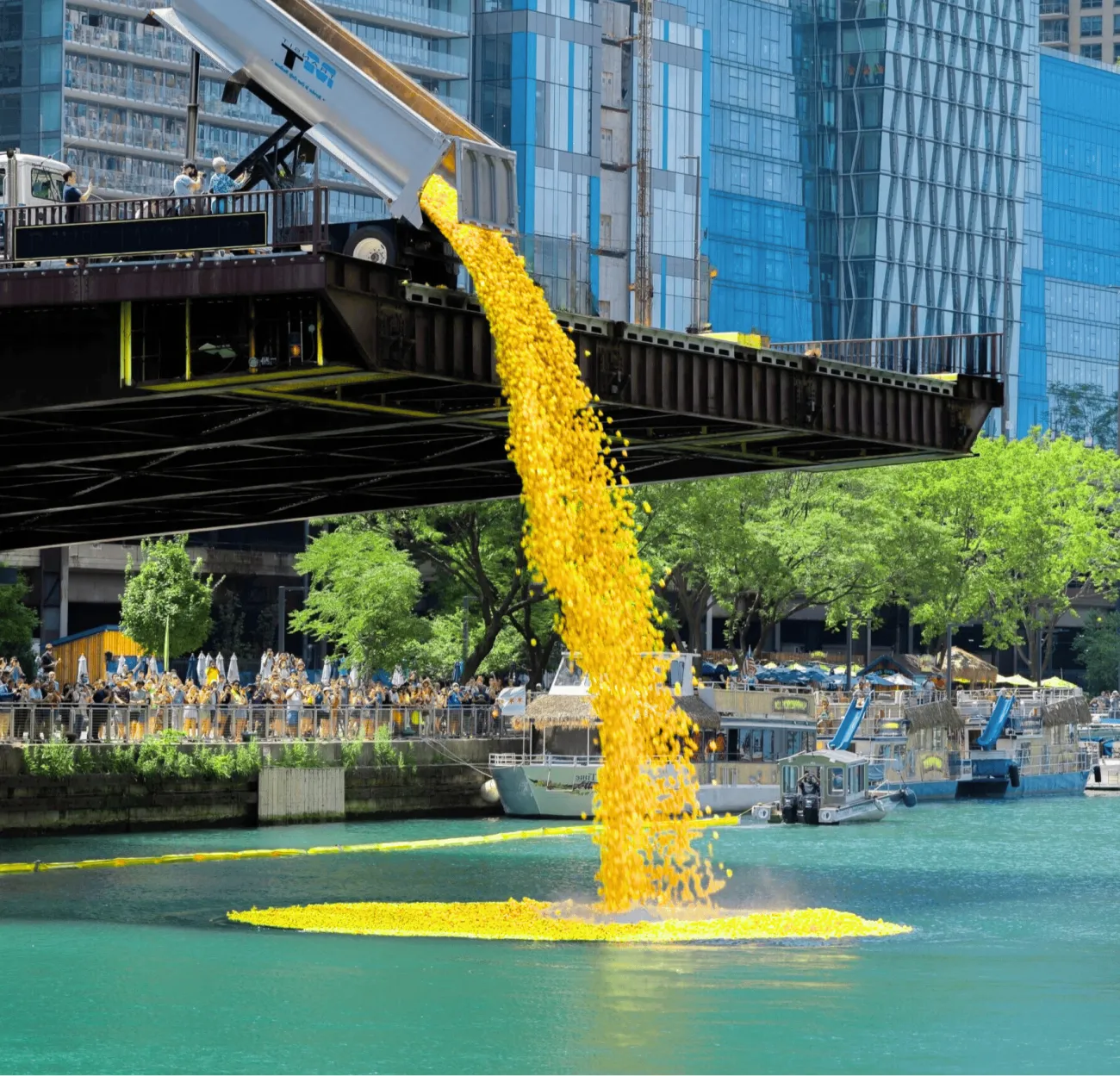
| Spectators | Essentially none | Hundreds to thousands on the bank |
| Media interest | Low | High: local TV covers a duck drop |
| Year-two growth | Usually flat, capped by the field size | Typically grows year over year |
| Planning runway | Often 6 to 12 months | 4 to 6 months recommended |
Why does a tournament cap out no matter how big your town is?
Because a golf course is a physical container, and containers have a size.
An 18-hole shotgun start typically puts one foursome on each hole, which is 72 players, and courses that split tee assignments into A and B groups can push the field toward 144. Past that the round takes six hours, play backs up on every par 3, and your golfers go home annoyed. So most charity tournaments live somewhere between roughly 100 and 144 golfers, and plenty never get near the top of that range.
Now run the money. At a mid-range $175 per golfer:
- 144 golfers × $175 = $25,200 in registration revenue
- Against $15,000 to $30,000 in event costs
Registration frequently doesn’t clear the cost of the tournament by itself. That isn’t a flaw in your event, it’s how the format works. A charity tournament is a sponsorship vehicle with a round of golf attached, and the golf is the excuse for the ask.
There’s no container on a duck race. Every adoption is a web transaction, so the 1,001st supporter costs you exactly the same as the first one, which is nothing.
- 500 supporters × $50 = $25,000
- 1,000 supporters × $50 = $50,000
There’s no bigger course to book and no second shotgun to schedule. That distinction matters most in a town of 8,000, where a duck race can reach a real slice of the whole community and a tournament reaches 144 people who happen to play golf.
Where does the money actually come from in each one?
Tournament revenue concentrates in a handful of checks. Duck race revenue spreads across hundreds. That’s a risk profile, not a matter of taste.
Picture a healthy tournament: one presenting sponsor, three to five mid-tier sponsors, eighteen hole sponsors at a few hundred dollars each, and six to ten corporate foursomes. Most of your net sits in the top eight relationships. When the presenting sponsor’s marketing director takes a job in another state, or two companies quietly trim their community giving, your April looks very different and there is no replacement available on that timeline.
Duck races spread the same dollars across a much wider base. Lose one sponsor out of thirty and you’ve lost a few hundred dollars, not your event. The publicly reported results from long-running races get large precisely because the revenue is broad and shallow rather than narrow and deep.
The sponsor ladder is longer, too. A tournament struggles to sell anything below the hole-sponsor tier, so the $250 hardware store gets a sign on a par 4 and nothing else. A duck race gives that same business a named duck, a social post, a mention on the PA, and a logo on a website their neighbors actually visit. We cover how to build those tiers in what you can offer your sponsors.
How much volunteer time does each one really take?
Total hours land in the same neighborhood. The shape is completely different, and the golf hours are harder to fill.
Selling foursomes is the toughest volunteer ask in fundraising. You’re asking a board member to phone a business contact and request $1,000 for a day of golf, and most people would rather do almost anything else. Then race morning starts at 6:30 with a registration table, hole monitors, contest holes, cart staging, scoring, a silent auction, and dinner service. You need able-bodied adults standing outside for eight hours on one specific Monday.
Duck race work distributes. Sponsor asks are the same skill, aimed at smaller checks and many more targets, which makes them dramatically easier to say yes to. Nobody spends a July morning parked at the 14th tee babysitting a hole-in-one contest that was never going to pay out, and nobody reconciles a stack of scorecards in a cart barn while the dinner buffet goes cold. Promotion happens on phones over several weeks. Drop day needs a crew, but it needs a crowd more. Retirees, students, and parents with a toddler on a hip can all do real work here, which makes it a far easier committee to staff.
What happens if it rains?
A tournament puts nearly all of its revenue on one weather-dependent day. A duck race collects most of its money before race day even arrives.
Rain out a tournament and you’re looking at a rain date that half your field can’t make, a course contract that doesn’t care, and catering already ordered. Some of those foursomes simply won’t come back, and refund requests start the same afternoon.
Adoptions, by contrast, run online for weeks ahead of the drop. Postpone the race and the money is already in your account. Hosts have moved a drop to a pool, a rented tank, or a livestream when the river wasn’t cooperating, and the fundraising outcome barely moved. That flexibility is a big part of why virtual and hybrid duck races work at all.
Which organizations should keep their golf tournament?
Plenty of them.
Keep the tournament if most of this describes you:
- A board member is a club member. If one relationship gets you the course donated or at a member rate, that single fact rewrites the entire cost analysis above.
- Five to ten corporate foursomes renew without being chased. Reliable, repeating corporate money is the hardest thing in fundraising to build, and it is the whole reason tournaments persist.
- A presenting sponsor is committed for multiple years. Don’t blow up a signed relationship to chase a bigger gross.
- Your top donors treat it as their social event. If the twenty people who fund your organization look forward to this Monday every June, the tournament is doing something a spreadsheet can’t measure.
- It has fifteen years of tradition and a waiting list. A full field with a queue behind it is not a fundraiser to fix.
- Your mission is golf-adjacent. Club foundations, caddie scholarships, junior golf programs. The event and the cause are the same story.
An organization checking most of those boxes doesn’t have an underperforming tournament. It has a relationship engine that also raises money, and swapping it for a duck race would be a mistake.
For a lot of these groups the smarter move isn’t replacing anything. It’s adding a duck race in a different season, aimed at the 900 families who were never buying a $175 tee time.
If your foursome list is shrinking, your net drops every year, and your committee dreads the ask, that’s not a reason to hate golf. It’s information.
What are the best alternatives to a golf tournament fundraiser?
The formats that most often replace a golf tournament are a pickleball or cornhole tournament, a clay shoot, a trivia night, a peer-to-peer campaign, and a duck race. Four of them are the tournament with the expensive part removed. One of them is a different instrument.
Pickleball and cornhole are the easiest sell to a board that likes what golf does. You keep the team entry, the corporate sponsor banners, the trophy photo for the newsletter, and you keep almost none of the venue bill. Better still, the field isn’t rationed by tee times, so a good year can be bigger than last year. A clay shoot runs the same team logic on a shorter day and tends to open doors at a different set of businesses. Trivia night is the cheapest of the group and the one most likely to stall around $4,000, because a bar’s back room holds what it holds.
A peer-to-peer campaign skips the venue entirely, which reads like pure margin until you watch one run. It lives on follow-up. Follow-up is the exact thing a volunteer committee stops doing in week three, once the easy shares are spent and what’s left is texting people who already ignored you once. If your board won’t post, it doesn’t work, and most boards won’t.
A duck race is the only option on that list that raises the ceiling instead of lowering the cost. The businesses that were never going to buy a foursome will buy a logo on a race site their customers are looking at, and unlike the foursome call, that conversation gets easier the second time you make it. It also asks for more money up front than anything else here. Our fundraiser comparison guide lines the economics up.
Frequently asked questions
Is a golf tournament fundraiser worth it?
It depends almost entirely on your sponsor base. Registrations typically cover only part of a tournament’s $15,000 to $30,000 cost, so the net comes from a handful of corporate sponsorships and foursomes. Organizations with five to ten reliable corporate relationships do well by it. Organizations without them run a large, exhausting event for a thin margin, and it thins a little more each year.
How many golfers can a charity tournament actually hold?
Roughly 100 to 144. An 18-hole shotgun start fields one foursome per hole, or 72 players, and courses that split tee assignments push the field toward 144. Beyond that, pace of play collapses. That ceiling applies whether your community has 5,000 people or 500,000, which is the core structural difference between a tournament and an online-adoption fundraiser.
How much does a duck race cost compared to a golf tournament?
Less, and the risk sits differently. Derby Duck packages start under $9,000 versus a typical $15,000 to $30,000 tournament budget, and duck race hosts usually pre-sell sponsorships so the event is funded before adoptions open. A tournament commits you to course deposits and catering minimums months before you know how many golfers will register.
How many supporters does a duck race need to out-raise a tournament?
About 500. At the $50 average adoption, 500 supporters produce $25,000, roughly what a full 144-golfer field grosses in registrations before it pays for the course. Double that to 1,000 supporters and you’re near $50,000. The average adopter takes ten ducks at $5 apiece, so the number you’re chasing is hundreds of people, not thousands.
Can we run a duck race and keep our golf tournament?
Yes, and many of our hosts do exactly that. Put them in different seasons so they don’t compete for the same sponsor dollars or the same volunteer stamina. The tournament serves your corporate donors and the duck race reaches families, so the two pull from largely separate pools of money.
What a golf tournament is, underneath
If your tournament is full, funded by loyal corporate sponsors, and beloved by your biggest donors, keep it. If it’s shrinking, or if you’re staring at a $20,000 course invoice and hoping enough foursomes show up, a duck race gets you a broader base of support without the venue risk. Plenty of organizations end up running both, in different months, for different people.
Stripped of the tradition and the good weather, a charity golf tournament is a fixed-capacity event you buy months before you sell it, resold one foursome at a time to about 120 people who were already giving you money.