How Much Can a Duck Race Fundraiser Raise? Real Numbers
Reported results from duck races we supply, from $30,000 a year in Tampa to six figures in Chicago, plus a method for estimating what yours would raise.
Duck race revenue has an enormous spread, and vendors love to quote the top of it. Every number below comes from a race we actually supply, followed by a method for estimating where your own would land.
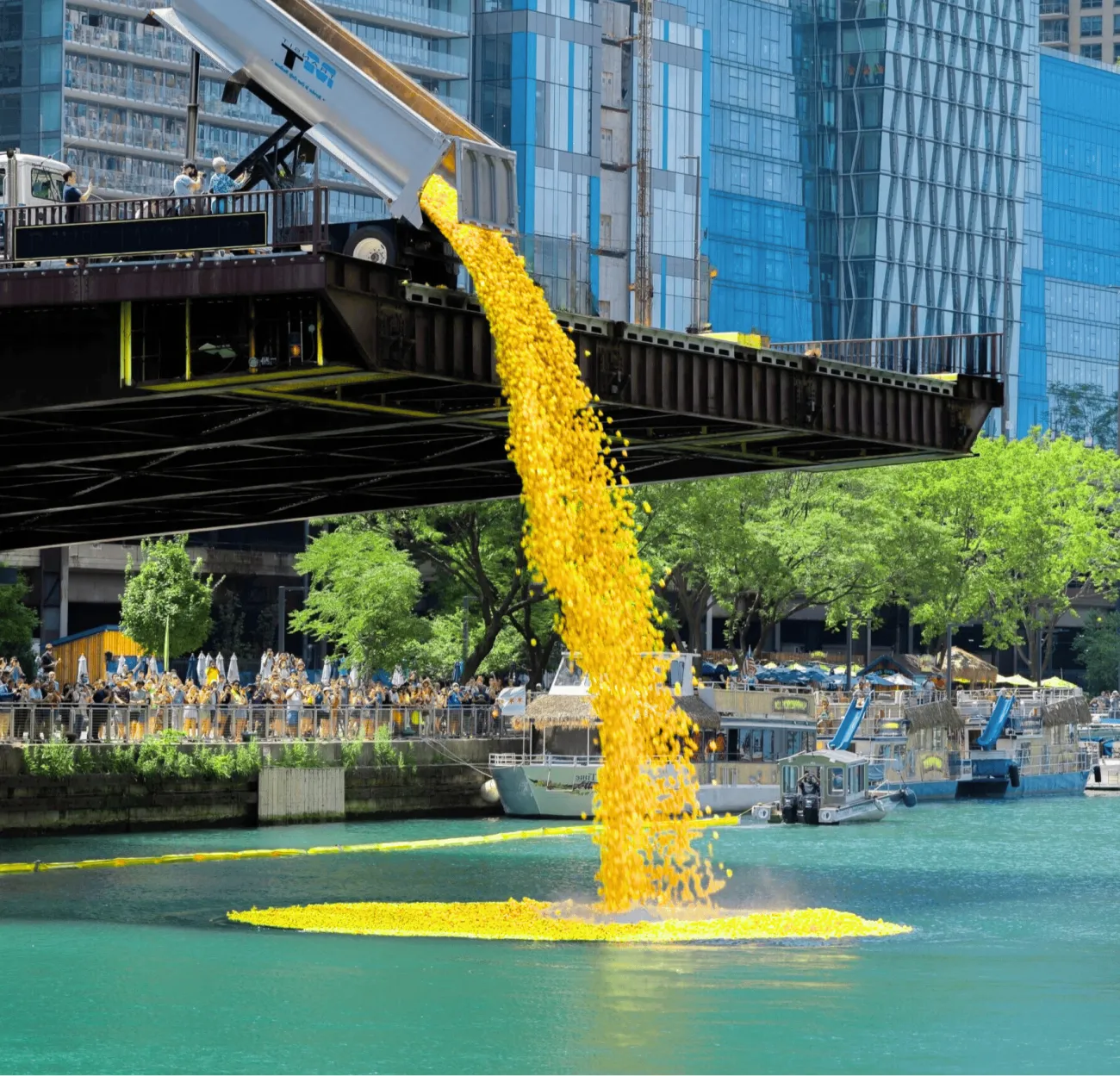
A typical first-year duck race grosses $20,000 or more. Established events run much higher: the Chicago Ducky Derby, which we supply for Special Olympics Illinois, has been reported in the $480,000 to $700,000+ range across recent years, while the Kiwanis Club of Tampa clears $30,000 to $40,000 every year. At $5 a duck and a $50 average adoption, $50,000 takes about 1,000 supporters, and races with more than 10 fundraising teams sell 2.3x more ducks.
What do real duck races actually raise?
Totals from long-running events give you the ceiling and the middle.
| Event | Reported result | Source of the figure |
|---|---|---|
| Chicago Ducky Derby, Special Olympics Illinois | $480,000 to $700,000+ range across recent years | Publicly reported. Our client |
| Kiwanis Club of Tampa | $30,000 to $40,000 per year | Publicly reported. Our client |
| Derby Duck Races, all clients since 1988 | $280M+ raised for 2,000+ organizations | Company-reported, ours |
The first two rows are races we supply, and both organizations have reported those figures publicly, so you can look them up. The last row is our own count of our own clients, which is a different class of number, and the table labels it that way.
Chicago is one of the largest charity duck races anywhere, and it has been running for decades, so read it as a ceiling rather than a forecast. Tampa’s Kiwanis club is the more useful row for a first-time host: thirty to forty thousand dollars, every year, from a service club in a real American city. That’s a target an ordinary organization with an ordinary volunteer roster can plan against.
How do you estimate what your race would raise?
Multiply the supporters you can genuinely reach by $50.
It works because the average adoption transaction on our race platform in 2025 was $50, which is about ten ducks at $5 apiece. Nobody adopts one duck. They buy a pack for the family and another in a coworker’s name. That’s the method, start to finish.
So the estimate is: (people you can actually reach) × $50 = your gross.
Three hundred supporters is $15,000. Six hundred is $30,000. A thousand is $50,000. Work it in the other direction if you have a goal already, which is exactly what our $50,000 first race breakdown does.
The hard part isn’t the multiplication. It’s being truthful about the first number. Count your board, your staff, your active donor list, your volunteer roster, and the realistic reach of your sponsors’ employee networks. Do not count “the town,” because the town does not know you exist yet.
What does each stage of a duck race look like?
Three tiers, with the caveat that separates them.
| Race stage | Ducks | Supporters at the $50 average | Gross at $5/duck | What it assumes |
|---|---|---|---|---|
| First-year, small town | 4,000–6,000 | ~400–600 | $20,000–$30,000 | Assumes a committed volunteer crew, 4–6 months of runway, and at least a few sponsors |
| Established, mid-size (years 3–5) | 10,000–20,000 | ~1,000–2,000 | $50,000–$100,000 | Requires repeat sponsors and a supporter list that grew every single year |
| Large metro signature event | 40,000+ | ~4,000+ | $200,000+ | Takes many years, media partners, and a committee that treats this as a real job |
Every gross column is arithmetic: ducks times $5. Every supporter column is ducks divided by ten. Swap in your own numbers and the structure holds.
Notice what those assumptions have in common. None of them is about the ducks. They’re about people, relationships, and time, which is where duck race revenue actually comes from.
What determines where your race lands?
Sponsorship, more than anything else.
Sponsors are the single biggest lever on a duck race, and the reason is plumbing, not psychology. When local businesses underwrite the event cost before adoptions open, every duck adopted afterward runs clean to the cause. That changes the pitch entirely. A host who can truthfully tell their community that 100% of adoptions go to the mission converts at a meaningfully different rate than one who can’t, and the sponsor logos themselves pull in those businesses’ employees and customers. Building those tiers is its own skill, and we’ve written up what you can actually offer sponsors.
After sponsorship, in rough order of impact:
Teams. Peer-to-peer teams are the other big lever. Across 37 completed races, those with more than 10 teams sold 2.3x more ducks and hit their goal 44% of the time versus 26%.
List size. Your existing donors and volunteers are the first several hundred supporters, and they convert far faster than strangers. An organization with 2,000 engaged email addresses and one with 200 are running different events. The size of the town around them barely matters by comparison.
Local media. A duck race is one of the most photogenic things a small newsroom will get all spring, which makes it unusually easy to pitch. Thousands of yellow ducks pouring down a river is a broadcast segment that writes itself. Coverage on the Thursday before race day moves real adoptions.
Years running. More on this below, because it’s the driver most first-time hosts underweight.
Community fit. A duck race is a family event. A church with a big children’s ministry, a school, a youth sports league, or a downtown with weekend foot traffic will outperform an organization whose supporters are all retired and dispersed.
Why is year one the hardest, and how much does a race grow?
Year one is the hardest because you’re selling something your town has never seen, and every subsequent year you’re selling something they remember.
That shows up in three specific ways. In year one you have no photos, so your marketing is a description. You have no previous winner to interview, so the local paper has no story angle. And your sponsors have no evidence, so the ask is a favor rather than a media buy.
In year two, all three of those flip. You have footage of ten thousand ducks going down a river and a family holding an oversized check. The paper covered it last spring and will cover it again. Sponsors saw their logo on the banner and can see the crowd size for themselves, so renewal conversations get dramatically easier, and the ones who declined last year start calling you.
That’s why Tampa’s Kiwanis club is described in dollars per year rather than one headline number. Duck races compound. A $22,000 first race that keeps its volunteers and its sponsors is worth far more over five years than a $45,000 first race that burned everyone out and never happened again.
Plan for a modest, well-run year one. Judge the decision on the five-year total.
When will a duck race raise less than you hoped?
When the fundamentals under it are missing, a duck race underperforms. Name that risk out loud before you budget around a number.
Four situations where we’d expect a disappointing result. You have no volunteer crew, so the tagging, sponsor outreach, and race-day work all land on one exhausted staffer. You have no sponsor relationships and no time to build them, so the event cost comes out of adoption revenue. Your date is under four months away. That’s outside the 4-to-6-month runway that works, and there’s no version of a compressed sponsor campaign that makes up the difference. Or your supporter list is genuinely small and you’ve budgeted as if the whole county will show up.
There’s also a fair case for a different event entirely. If your organization’s money comes from a few dozen major donors rather than a broad community, a well-run gala or a direct major-gift campaign will almost certainly outraise a first-year duck race, because a duck race is a breadth instrument. It’s built to turn 600 people into $30,000, not six people into $30,000. Know which shape your donor base has before you pick the tool, and if you’re still weighing formats, our side-by-side of ten common fundraisers sorts the breadth instruments from the depth ones.
And if the number you need is under $5,000, the flat cost of a production package is too big a share of the take. The full cost breakdown walks through exactly where that line sits.
Frequently asked questions
How much can a duck race fundraiser raise?
A typical first-year duck race grosses $20,000 or more, and established events raise far more than that. The Kiwanis Club of Tampa raises $30,000 to $40,000 a year, and the Chicago Ducky Derby for Special Olympics Illinois has been reported in the $480,000 to $700,000+ range. Both are races we supply. For your own estimate, take the supporters you can genuinely reach and multiply by the $50 average adoption.
How much do duck races make in profit, not just gross?
Gross minus a flat production package, minus permits, insurance, and any prizes you couldn’t get donated. Packages start under $9,000, and the tier-by-tier numbers are in our full cost breakdown. Because the price is flat and not a cut of what you raise, your margin improves every year the race grows. Hosts whose sponsors underwrite the event cost keep close to the whole gross.
What is the biggest duck race fundraiser?
The Chicago Ducky Derby, which we supply for Special Olympics Illinois, is one of the largest, with recent years reported in the $480,000 to $700,000+ range. It is a decades-old event with major corporate sponsorship, media partners, and the kind of citywide recognition that takes twenty years to build. Read it as a ceiling, not a first-year forecast.
How many supporters do we need to raise $50,000?
About 1,000. At $5 per duck, $50,000 is 10,000 ducks, and the 2025 average adoption on our race platform was $50, or roughly ten ducks per supporter. So 10,000 divided by ten is 1,000 people, not 10,000. That’s a large congregation, a mid-size school community, or one well-networked service club working its lists.
How much does a duck race grow each year?
There’s no fixed rate, but growth is the norm rather than the exception. Year two starts with photos, press coverage, a past winner to interview, and sponsors who already saw the crowd for themselves. The compounding is why a club like Kiwanis Tampa reports $30,000 to $40,000 every year rather than one good spring. Judge the decision on a five-year total, not on year one alone.
Estimate from your list, not from the headline
Whatever number goes in the board email, be ready to say where it came from. “Six hundred people we can actually reach, times the $50 average” survives the follow-up question. “We read about a race in Colorado that did $204,000” does not, and whoever asks will be right to ask.
The other thing worth saying plainly is that year one is the smallest number this event will ever produce for you. A first race that clears $20,000 gross is an ordinary first race, and it looks nothing like year five, which is a different event wearing the same name: a date people already have, sponsors who saw last year’s crowd, a duck count you size up on purpose, and a committee that’s done it four times. Nobody’s biggest year was their first one. They got there by not stopping.