Duck Race vs. Crowdfunding: Which Raises More for Nonprofits?
Crowdfunding is cheap to launch but fades by year two. Here is how a duck race compares on cost, average gift size, sponsorship, and repeat revenue.
Crowdfunding costs almost nothing to start, which is exactly why so many organizations reach for it first. The trouble tends to show up in year two.
A duck race usually raises more. A crowdfunding page is a bare ask, so gifts arrive one at a time, typically in the $20 to $30 range, and a campaign drawing 100 to 300 donors lands somewhere between $2,000 and $9,000. Duck adoptions run $5 each and our race platform’s 2025 average was $50 per supporter, so 500 supporters is $25,000, less a package starting under $9,000. Crowdfunding still wins when you need cash in three weeks.
What separates the two?
One of them gives your supporter something to buy. The other asks them to give you money because they like you.
A crowdfunding or peer-to-peer campaign has no venue, no date, no ducks, no finish line. It’s a page with a thermometer on it. Everything that would normally create urgency has to be manufactured out of thin air, usually by a volunteer writing their fourth Facebook post of the month and quietly hating it.
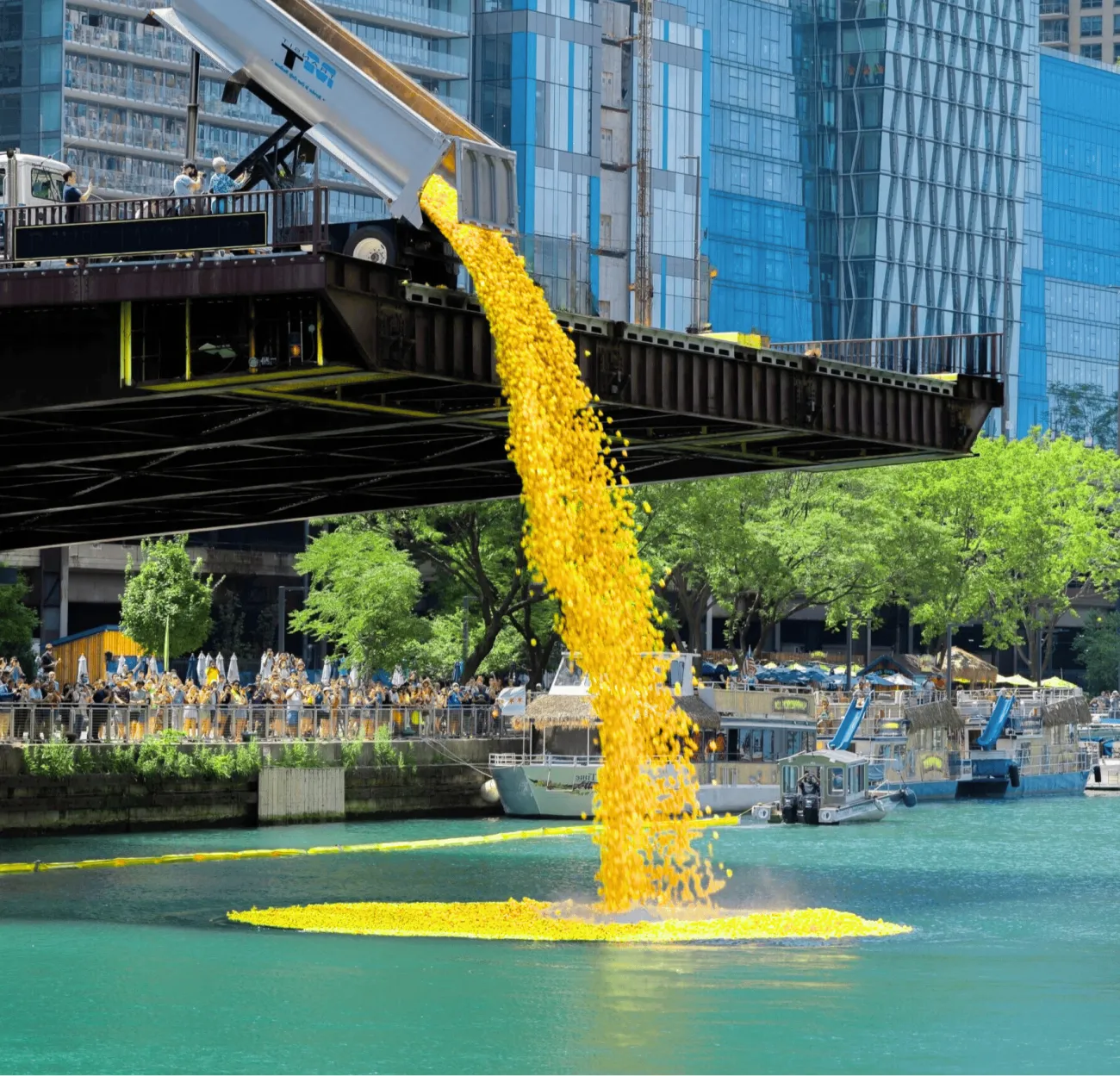
A duck race gives your supporter something to buy that pays off in public. Five dollars gets them a numbered rubber duck in a real race, on a real date, with real prizes, and half the town watching. That’s not a small psychological difference. It’s the reason the average adoption is a pack of ten rather than a single gift, and it’s why people forward the link to their brother-in-law instead of scrolling past it.
Both are online. Both let someone give from their couch. Only one of them gives them a reason to.
How do the two compare side by side?
| Crowdfunding / peer-to-peer | Duck race | |
|---|---|---|
| Upfront cost | Near zero, plus platform and processing fees | Flat package cost, known before you commit |
| What the supporter gets | A thank-you and a receipt | A numbered duck in a real race, plus prizes |
| Typical transaction | One gift at a time, commonly $20 to $30 | $50 average adoption (DDR race platform, 2025) |
| Built-in deadline | None; you have to invent urgency | Race day sets it for you |
| Reason to share it | Loyalty to your organization | Something is happening, and it’s fun |
| Sponsorship revenue | Hard to sell; little to put a logo on | A primary revenue line |
| Geography | No limit | No limit on adoptions; the crowd is local |
| Volunteer load | Very light | Real: committee, sponsors, race day |
| Year two | Usually softer than year one | Grows; typical first race is $20,000+ gross |
| Best fit | Emergencies, capital needs, scattered constituencies | An annual signature event |
Why does year two of a crowdfunding campaign usually underperform?
Because novelty and urgency are the only two engines a bare ask has, and neither one survives repetition.
Think about what made the first campaign work. Something happened. The roof failed, the van died, the family needed help, the matching gift was about to expire. Your community responded to a specific emergency with a specific end date, and they responded fast.
Now run it again twelve months later with no emergency. The page looks the same. The copy sounds the same. The ask is the same size. What’s changed is that everyone has already done this once, and the second time it reads less like a crisis and more like a subscription. Board members who forwarded the link to forty people in year one forward it to eight. Your most reliable donors start to feel like they’re being billed.
A duck race runs on a different growth pattern. It becomes a thing on the calendar. People ask when it is. Sponsors renew before you get around to calling them. The local paper lists it without being asked, and last year’s winner shows up wanting to defend the title. Repetition is what makes it work, which is the exact opposite of the crowdfunding curve. Races typically grow year over year.
Why does the average duck adoption land at $50?
Nobody adopts one duck.
That’s the answer, and it’s the number most first-timers get wrong. In 2025, the average adoption on our race platform was $50, which at $5 a duck is about ten ducks per supporter. People buy in packs. A few for themselves, a few for each kid, one in a coworker’s name, one for the dog. It’s cheap enough to be an impulse and structured enough that buying more feels like better odds.
Watch what that does to your goal. A $25,000 race is 5,000 ducks, which sounds impossible until you divide by ten and get roughly 500 supporters. A $50,000 race needs about 1,000 people. Not 10,000 people. One thousand, each doing something that costs less than a family dinner out.
Try to get to $25,000 on a crowdfunding page and you’re stacking individual gifts with nothing built in to make any one of them bigger. At a typical online gift of $20 to $30, that’s roughly a thousand separate yeses. At a $50 average adoption, it’s five hundred, and not one of them had to be asked twice.
Run the campaign total the same way, using $25 as a working midpoint. A hundred donors is $2,500. Three hundred donors, which is a good showing for a small organization with an engaged board, is $7,500. That’s the band most small-nonprofit campaigns land in, and it’s a perfectly respectable outcome for a page that cost you nothing but evenings. It’s also under half of what 500 duck adopters leave you once a package under $9,000 comes out of the $25,000.
Isn’t a duck race just peer-to-peer fundraising with a mascot?
Yes, essentially, and that’s the strongest argument for it.
Everything a peer-to-peer platform sells you, a duck race already does. Individual fundraising pages. Team competition. Leaderboards. Social sharing with a personal link. Sponsors who bring their own networks. And the teams matter: races with more than 10 of them sold 2.3x more ducks in our data.
The difference is that a P2P campaign asks your captains to sell an abstraction, while a duck race gives them a product and a deadline. Set up an adoption page per classroom and watch fifth grade decide to bury fourth grade. Give each fire station its own link and let Ladder 12 talk trash to Engine 4. Give your board members a page apiece with their name on it. Same mechanics, same viral loop, except at the end the ducks actually go in the water and somebody’s grandmother wins a kayak.
Sponsorship is the other piece crowdfunding can’t really replicate. A local business will happily put its logo on a race website, a banner at the drop, and a PA announcement, and that revenue often covers your event costs before the first duck is adopted. There’s much less to sell a sponsor on a donation page. If you want a picture of how far that goes, our breakdown of what you can offer sponsors lays out the tiers.
What does each one actually cost?
One of them is nearly free and the other has a real, flat, known price. Put that in front of your board before anything else.
On the crowdfunding side you’ll usually pay payment processing in the range of a few percent per transaction, and sometimes a platform fee on top. Some consumer platforms add a suggested tip at checkout, so check the platform’s terms. Beyond that, your cost is the evenings of whoever ends up writing the Facebook posts.
A duck race is a purchased program: the ducks themselves, a branded adoption website, print and marketing materials, sponsorship design, mobile-friendly adoption software, race-day planning, and consultation from a team that’s done this since 1988. Derby Duck Races packages start under $9,000, and the full cost breakdown walks through what each tier includes.
The tradeoff, in one line: crowdfunding has a lower cost and a lower ceiling. A duck race has a real cost and a much higher ceiling, and most hosts line up sponsors specifically so that cost is covered before adoptions open. Which risk profile fits depends on your balance sheet.
When is crowdfunding the better choice?
Pick crowdfunding when any of these describe you:
- There’s a genuine emergency. A fire, a flood, a medical crisis, a furnace that died in February. A duck race takes four to six months to do properly. A crowdfunding page takes an afternoon. When money is needed in three weeks, this isn’t a close call.
- The money already has a real deadline on it. A matching gift that expires, a closing date on a building, a grant that needs a match by the 30th. Real deadlines supply the urgency a bare ask otherwise has to fake.
- Your people are scattered. Alumni across 40 states, a diaspora community, a rare-disease advocacy group. If there’s no local crowd to gather, the biggest advantage of an event evaporates, and you should fundraise where your people are.
- Volunteer capacity is zero. Two staff and one part-timer cannot run a signature event, and a race those three have no time to promote will disappoint you. Say that out loud in the meeting rather than finding out in month three.
- You want to test an idea cheaply. A small campaign tells you whether anyone cares before you commit real budget.
It’s a different tool for a different job. Organizations that run both usually keep an always-on donation page for the year and use the duck race as the moment that brings everybody back.
What are the best alternatives to a crowdfunding campaign?
The alternatives to a crowdfunding campaign are a deadline-driven email or direct-mail appeal, a peer-to-peer challenge with team pages, a product sale, and a duck race. Three of them skip a full event build. One of them changes the ceiling.
An appeal with a real deadline on it still beats an evergreen donation page at most small organizations, and it isn’t close. A page that’s been sitting there since 2019 asks nothing of anybody. A letter that says the roof gets fixed by March 15 or it doesn’t asks something specific, and specific is what gets answered. Direct mail costs postage and outperforms email at exactly the ages you’d guess. A peer-to-peer challenge with team pages layers competition on top of that same ask, which helps, though your captains are still out there selling an abstraction to their friends, and most of them will send one message and go quiet.
A product sale is the easiest yes on the list. People buy things, the vendor handles fulfillment, and half or more of every dollar your supporters spend goes to a company in another state. That’s a fine trade when the goal is small and the deadline is close, and a bad one to build a decade on.
Then the duck race, which belongs in a different category and should be judged as one. Real setup, real cost, four to six months, and a ceiling none of the others have, because you’re building a thing a town shows up to instead of a message a town scrolls past. Our fundraiser comparison guide lines them up on cost, risk, and reach.
Frequently asked questions
Is a duck race better than GoFundMe for a nonprofit?
For a recurring annual fundraiser, usually yes, because a duck race hands supporters something to buy and a date to show up for. Adoptions run $5, and the 2025 average transaction was $50 per supporter, which is about ten ducks. For a one-time emergency that needs money in weeks rather than months, crowdfunding wins outright. It costs almost nothing and launches the same afternoon.
Can you run a crowdfunding campaign and a duck race together?
Yes, and the smartest version runs the peer-to-peer piece inside the race. Give each team, classroom, or board member an adoption link of their own, then let fifth grade’s determination to beat fourth grade do the work a generic donation page can’t. You get the P2P mechanics plus a real event, a real deadline, and prizes at the end.
Why do crowdfunding campaigns raise less the second year?
Because the first campaign ran on novelty and an emergency, and neither one repeats. A year later the page looks identical, the ask is identical, and the board member who forwarded it to forty people treats it as routine. Events go the other way. They build a following, keep their sponsors, and get easier to promote every year they run.
Do supporters have to attend the race to adopt a duck?
No. Most adoptions happen online, often from people who live nowhere near the water. A grandmother two states away adopts ten ducks for her grandkids, and sponsors’ employees adopt from their desks between meetings. Derby Duck Races also runs fully virtual and hybrid races, where the drop is streamed and the winning numbers go out online.
How long does a duck race take to set up?
Plan on four to six months from first meeting to race day. That runway covers locking your date and your stretch of water, building the sponsor list and making the asks, launching your adoption website, and running six to eight weeks of community promotion. Faster is possible. Sponsorship is just the piece that suffers when the calendar gets squeezed, and sponsorship is where the money is.
What an ask can’t do
Pick crowdfunding when you need money fast and cheap. There’s no shame in a well-written page that closes a $6,000 gap in three weeks, and plenty of organizations should run one this month.
But an ask, however good, can only ask. It can’t give a town a Saturday afternoon. It can’t hand a seven-year-old a numbered slip of paper and a reason to scream at a pond. It can’t put a hardware store’s logo where four thousand of its neighbors will see it, or give a grandmother in Arizona something to text her daughter a photo of. An event does all of that on the way to collecting the money, and those are the things people still remember in year five, long after the donation page has gone quiet.