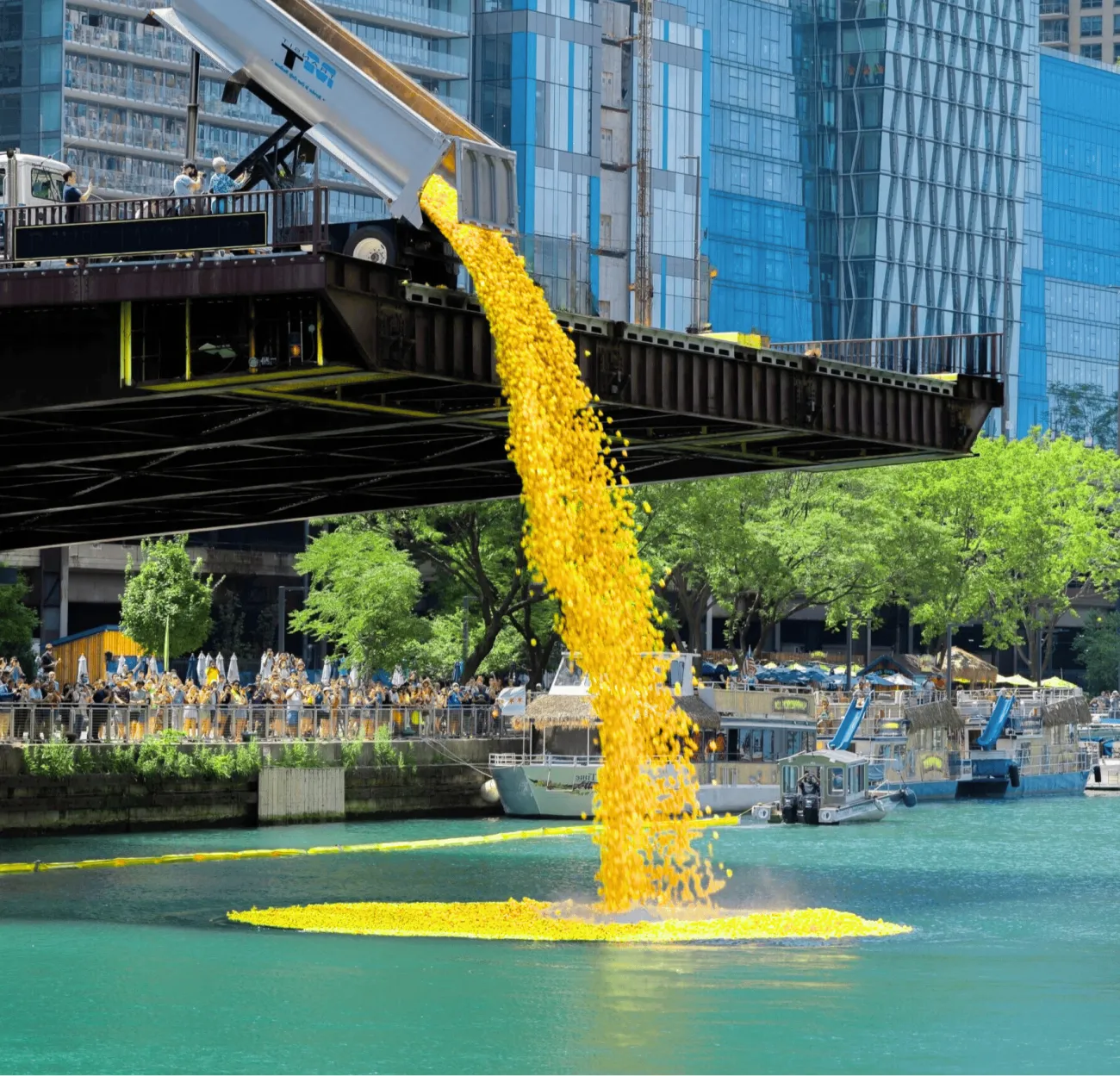
Duck Race vs. Gala: Which Fundraiser Actually Nets More?
Galas gross big and net small. A line-by-line look at catering, venue, and AV costs versus a duck race, and when the gala is still worth keeping.

Two nonprofits announce the same headline: $120,000 raised. One threw a gala, the other dropped rubber ducks in a river, and only one of them gets to keep most of it.
A gala nets more in year one if you can fill the room: a $100,000 gala typically clears $40,000 to $60,000 after catering, venue, and AV. A duck race sells a $5 duck against one flat cost, risks less, reaches households a gala never will, and improves its margin every year. A $20,000 first race nets about $11,000 against a package under $9,000; $40,000 in adoptions nets $31,000. Keep the gala, add the race.
What does a gala actually cost to put on?
Almost every line in a gala budget is priced per guest, so the cost climbs right alongside the guest list. Venues vary enormously by market, so treat these as typical ranges rather than quotes:
- Catering. A plated dinner at a hotel or country club generally runs $75 to $125 a head, with a 20% to 24% service charge landing on top of that, plus tax.
- Venue. Frequently bundled into a food-and-beverage minimum you owe whether or not the room fills.
- Bar. Open or consumption, it’s real money either way.
- AV. Mics, screen, projector, uplighting, and a tech to run the show. Usually a few thousand dollars, more once you add a mission video.
- Decor. Centerpieces, linens, a step-and-repeat. Fifty to a hundred fifty dollars a table disappears before anyone notices.
- Print. Save-the-dates, invitations, reply cards, programs, table numbers, signage, sponsor boards.
- Talent. A benefit auctioneer who knows how to work a paddle raise typically charges a few thousand, and usually earns it back.
- Everything else. Photography, insurance, valet, security, gift bags, and the deposit you forfeit if the date moves.
Run one scenario with round numbers. Three hundred guests at a $150 ticket brings in $45,000. Catering at $90 a head is $27,000, and a 22% service charge pushes that toward $33,000. Add $12,000 for AV, decor, print, and the auctioneer, and roughly $45,000 walks out the door.
Your entire ticket revenue is gone and you haven’t funded one hour of programming. That isn’t a broken gala. That’s how galas work. The ticket buys the plate. Net arrives later, from sponsorships, the live auction, and the paddle raise.
How do a gala and a duck race compare head to head?
Side by side, on the dimensions that actually change the decision:
| Gala | Duck race | |
|---|---|---|
| What you sell | A seat at dinner, typically $100 to $250 | A duck adoption, $5 |
| Cost structure | Mostly per guest, rises with attendance | Mostly fixed, set before you start |
| Cost to attend | Ticket required | Free |
| Who shows up | 200 to 400 people, most already on your list | Hundreds to thousands, many brand new |
| Where net comes from | Sponsors, live auction, paddle raise | Adoptions plus sponsorships |
| Planning runway | Commonly 6 to 12 months | 4 to 6 months |
| If attendance dips | You still owe the food-and-beverage minimum | Online adoptions are already banked |
| Margin as it grows | Roughly flat, more guests means more plates | Improves, the fixed cost doesn’t move |
| Best at | Major-donor cultivation and the big ask | Reach, acquisition, and net margin |
Why does a gala gross big and net small?
Because a gala’s costs are variable and a duck race’s are mostly fixed. Adding 100 guests adds 100 plates at $90 plus service charge, plus chairs, bar, and linens. Revenue per seat rises and cost per seat rises with it, so margin barely moves no matter how well you sell tables.
A duck race prices the other way. The ducks, the branded adoption website, the print materials, the sponsorship design, and race-day planning come as one package set before your first adoption. Packages start under $9,000, and that number doesn’t change when you sell 4,000 more ducks:
| Adoptions sold | Fixed event cost | Net | Margin |
|---|---|---|---|
| $20,000 | $9,000 | $11,000 | 55% |
| $40,000 | $9,000 | $31,000 | 78% |
| $60,000 | $9,000 | $51,000 | 85% |
Growth pays you twice there, once in revenue and once in margin. It cuts the other direction too, which we’ll get to.
Which one reaches people who’ve never heard of you?
The duck race, and it isn’t close, because a gala ticket price is a filter and free isn’t.
Think about who buys a $175 seat. Someone who already knows your name, already believes in the work, and is already in your database. Look around the ballroom at your own gala and you could have named 250 of the 300 faces in advance. Deepening those relationships is genuinely valuable. Acquisition it is not.
There’s no ticket to a duck race, no dress code, no babysitter to book. Five dollars gets you a duck. The man who runs the hardware store two blocks over, who has never rented a tux in his life and has thrown away four of your gala invitations without opening them, buys ten ducks on a Tuesday because his kid asked. Now he’s on your list, and his first gift came wrapped in an afternoon he enjoyed.
In 2025, the average adoption on our race platform was $50, which works out to about ten ducks per supporter. That one number changes the size of the problem. A $40,000 race needs roughly 800 supporters, not 8,000. Eight hundred households is reachable for a mid-size nonprofit with an engaged board, and a large share of them will be people you’ve never spoken to.
How much of your team’s year does each one take?
Galas tend to own an entire quarter of the development calendar, and the work is unglamorous. Table sales. Seating chart revisions every time a board member’s guest cancels. Dietary restrictions. The run of show. The sponsor deck. Auction procurement, which is a months-long slog worth pricing out on its own. Then the acknowledgment letters, which your accountant will want to review, because the deductible portion of a gala ticket is not the whole ticket.
Duck races want 4 to 6 months of runway, and the shape of the work is different. Sponsors get worked hard up front so the event is funded before the first duck is adopted. Then the adoption push, which is one link you send to your board, your donors, and your sponsors’ employees. Then race day. Nobody redraws a seating chart at eleven at night because a board member’s guest cancelled, and nobody calls a banquet manager about a shellfish allergy.
Neither one is free. One spreads across a quarter of meetings and spreadsheets. The other spikes.
When is a gala clearly the better choice?
Keep the gala if a meaningful share of your budget comes from a few dozen households. Reach isn’t your problem, and reach is the problem a duck race solves.
There are things a gala does that a duck race structurally cannot:
- A $25,000 ask happens face to face. You can’t run a paddle raise from a riverbank. A gala seats a prospect next to your board chair and a parent whose kid your program helped, then hands a microphone to someone who knows how to ask a room for money.
- Seating is strategy. Who sits next to whom is a cultivation plan disguised as a floor plan.
- Planned giving starts over dessert. Bequest conversations tend to begin in person, with someone who’s just had a very good night.
- Prestige is a real product. Some corporate sponsors buy a black-tie table because that’s where their executives want to be seen. A duck sponsorship is a different sale to a different buyer.
- Honoring someone imports their whole network. Name an award after a retiring board chair and their circle buys tables.
Skip the duck race entirely if you need cash inside eight weeks, or if you can’t field a committee of eight to twelve people who’ll show up when they say they will. And read that margin table from the other end: a race that pulls only $12,000 in adoptions against a $9,000 package nets $3,000. Below roughly $15,000 in adoptions, which is about 300 supporters at the $50 average, the economics stop being interesting. If you can’t picture 300 households taking part, run something else this year.
Should you keep the gala and add a duck race?
For most organizations, yes, because the two events work on different donor tiers and don’t compete for the same dollar.
Your gala deepens the top of the pyramid. The duck race widens the base. A family that adopts $50 worth of ducks this spring is exactly the family you invite to a gala table in three years, and there’s no version of a development plan where having more donors is a problem.
Two practical cautions. Don’t stack them inside the same eight weeks, since they draw on the same volunteers, the same sponsors, and the same email list. Spring race, fall gala is a comfortable rhythm. Expect a different sponsor roster for each, too, because a duck race sells visibility to a family crowd while a gala sells prestige to a boardroom. Plenty of organizations run this same math against the golf tournament and end up keeping two of the three.
What are the best alternatives to a gala fundraiser?
The realistic alternatives to a gala are a scaled-down donor luncheon, a peer-to-peer campaign, a golf tournament, and a duck race. Price all four before you sign another hotel contract, because the hotel contract is the decision. Everything after it is just details.
A donor luncheon is the gala with the expensive half removed. You keep the room, the program, the video, and the ask. You lose the plated dinner, the open bar, and the band, which together are often most of what the evening costs. Nobody dresses up, nobody stays until eleven, and the giving holds up better than skeptical board members predict, because the people who write your biggest checks were never coming for the salmon. The catch is that a luncheon is even more explicitly an inside event. It won’t bring you anyone new.
A single-week peer-to-peer campaign costs almost nothing and lives or dies on whether your board will post. That sounds like a small dependency. It isn’t. A golf tournament swaps your guest list for a corporate one, which is genuinely useful if your members have foursomes to sell, though the field caps at roughly 100 to 144 golfers no matter how well it goes.
The duck race is the one that trades prestige for reach, and it’s the only trade of that kind on the list. You give up the room, the tuxedos, and the paddle raise, and you get a few thousand households who’d never have opened a gala invitation, at a cost you know before you start. Our fundraiser comparison guide sets the numbers side by side.
Frequently asked questions
How much does a gala actually net?
Most galas net far less than they gross. Catering, venue, AV, decor, print, and talent commonly consume 40% to 60% of gross revenue, and ticket sales alone rarely cover them. The net usually comes from sponsorships, the live auction, and the paddle raise. Ask your finance staff for last year’s net figure, not the number that went in the press release.
Is a duck race cheaper to run than a gala?
Yes, and the shape of the cost matters more than the size of it. A duck race carries a flat event cost, with packages starting under $9,000, that doesn’t rise when you sell more adoptions. A gala’s biggest expenses are priced per guest, so they climb with attendance. That’s why a duck race’s margin improves with scale while a gala’s stays roughly where it started.
Can a duck race replace our annual gala?
Sometimes, but think hard if the gala is where your major-donor asks happen. Duck races are excellent at reach, acquisition, and net margin, and poor at getting a $25,000 pledge out of one person in one evening. Organizations with a broad community base often do replace the gala. Organizations funded by 40 households usually shouldn’t.
Do duck race supporters ever become real donors?
They can, if you treat the adoption as a first gift instead of a transaction. Every adopter hands you a name, an email address, and a positive first impression, which is more than most acquisition channels produce for $5. The organizations that get the most from a duck race move adopters into their regular donor communications the week after race day.
Keep the ballroom, add the river
Galas and duck races answer different questions. If you need to deepen relationships with the fifty people who fund you, book the ballroom and hire a good auctioneer. If you need a thousand new households, an event that’s funded before it starts, and a number that grows every year, put ducks in the water.
The ballroom will always do one thing the river can’t. A duck race can put ten thousand people in your corner. It cannot put your executive director at table four, three feet from a woman who’s quietly given $500 a year for eleven years, on the night she decides to make it $50,000. Galas do that. They’ve been doing it for a century, in rooms exactly like the one you’re thinking of cancelling, and they’ll still be doing it long after every one of us has stopped arguing about it.