Duck Race vs. Silent Auction: Which Raises More Money?
Silent auctions cost more in volunteer hours than anyone counts. A head-to-head look at procurement, checkout, and margin against a duck race.

Silent auctions look nearly free on paper, since the items are donated and the tables are borrowed. The cost shows up somewhere your budget doesn’t track.
The duck race nets slightly more, and per volunteer hour it’s a wash. A 100-item auction netting $25,000 across about 210 hours returns roughly $119 an hour. A duck race grossing $40,000 from 800 supporters at our race platform’s $50 average nets $28,000 to $29,500 across 250 hours, about $115. Decide on what carries forward: procurement restarts at zero every year, while an adopter list and a sponsor roster don’t.
Where does a silent auction’s cost actually hide?
In hours, not dollars. That’s why auctions survive board scrutiny so easily. Nothing on the expense line looks alarming, and the labor never gets priced.
Walk through what a 60-item auction really involves:
- Procurement. Your auction chair writes a donation request letter, gets it approved, prints 200 copies, and then walks into local businesses one at a time. Most say no or say nothing. The ones that say yes need two follow-ups and a pickup, which means a volunteer driving across town for a gift basket.
- Cataloguing. Photographing each item, writing a description that makes a $40 car wash package sound appealing, assigning lot numbers, setting minimum bids and bid increments.
- Display. Tables, easels, tablecloths, item cards, baskets, cellophane, ribbon, and the four hours of setup where two volunteers discover the tablecloths are the wrong length.
- Bidding. Paper sheets mean a volunteer stationed nearby all night, and the last twenty minutes where four people lean over the same sheet, a bidder writes $85 across the $80 above it, and the volunteer with the clipboard has to decide which one counts. Mobile bidding software typically charges either a percentage of proceeds or a platform fee plus card processing, and your treasurer loads all hundred items into it the week before.
- Checkout. The line at the end of the night, the winners who already left, the credit card that declines, the item that goes home with the wrong person.
- Cleanup. Unsold items, unclaimed items, and the ones nobody wants to store.
None of that appears in the budget. All of it appears in your volunteers’ calendars.
How do a silent auction and a duck race compare?
Head to head on what changes the decision:
| Silent auction | Duck race | |
|---|---|---|
| What you sell | 40 to 100 different items, each priced differently | One product, $5 per duck |
| Where inventory comes from | Solicited from local businesses, one at a time | Provided as part of the event package |
| Procurement season | Two to four months of asking | None |
| Cash outlay | Often near zero if items are donated | Flat package, set before you start |
| Where selling happens | In a room, on a deadline | Online, over weeks, plus race day |
| Volunteer hours | Heavy and spread across months | Concentrated in the sponsor push and race week |
| Ceiling on one transaction | High, a good lot can bring $3,000 | $5 per duck, but supporters average $50 |
| Typical result | $10,000 to $40,000 net for a standalone auction | $20,000+ gross in year one, less a flat package |
| Reach | Whoever is in the room | Anyone with the link |
| Risk | Unsold items, weak procurement year | Under-selling against a fixed cost |
| Best at | Adding revenue to an event you’re already holding | Standing on its own and growing yearly |
What do auction items really sell for?
Less than their stated value, most of the time.
Auction organizers commonly plan on items clearing somewhere in the range of 60% to 80% of fair market value. A handful of hot lots blow past that. A long tail sits at or just above the minimum bid. Play that out with one real example.
Say a local salon donates a $200 gift certificate. It sells for $130. The salon is out $200 of services, your organization received $130, and the winning bidder got $70 of value for free. Under US tax rules a bidder can generally only treat the amount paid above fair market value as a charitable contribution, which in this case is nothing, so the deduction they were expecting doesn’t exist either. Confirm the treatment with your tax advisor before you put anything about deductibility on a bid sheet. Meanwhile you spent your relationship capital with that business for the year on a $130 outcome.
That salon owner gets asked by six other nonprofits this quarter. Every one of them is drawing on the same well.
Duck adoptions don’t have this problem, because a $5 duck is worth $5 and everyone knows it going in. There’s no discount to the donating business and no gap between what the adopter paid and what you banked.
How many volunteer hours per dollar does each one take?
This is the number to run before you commit. Here’s the arithmetic, with room for your own figures.
Start with the auction. Netting into the typical $10,000 to $40,000 range takes more than the 60-item version above, so call it 100 lots in a room of 300 to 500, averaging $250 a lot. That’s $25,000. Procurement at 1.5 hours a lot is 150 hours. Cataloguing, display, and setup, call it 40. Checkout and cleanup, another 20. So $25,000 across 210 hours is roughly $119 per volunteer hour. A thin procurement year at the bottom of the range, $10,000 across those same 210 hours, is closer to $48.
Now the duck race. 800 supporters at the $50 average adoption is $40,000 gross. Subtract a flat package starting under $9,000. Then subtract the costs that sit outside any package and that we tell every host to budget for anyway: a possible gaming or waterway permit, special-event insurance, and prizes if a sponsor doesn’t donate them, which together commonly run $1,500 to $3,000. Net lands between $28,000 and $29,500. Committee meetings, the sponsor push, the promotion window, and race day, call it 250 hours across everyone. That’s about $115 per volunteer hour.
Which puts the auction slightly ahead. Run both sides on the same assumptions and they’re roughly even per hour. What the per-hour figure can’t see is next year: an auction’s 210 hours come back in full every season, because items don’t carry forward, while a race’s sponsor list, adoption site, and donor file do.
Swap your own figures in and it moves again. If your auction chair is a procurement machine with twenty years of local relationships, your hours drop, your average lot climbs, and the auction wins outright. If you can’t put a real committee together, a race’s 250 hours land on two exhausted people and the math gets ugly fast. Neither number settles it. You just want both before the board votes.
What happens to the items nobody bids on?
You own them. That’s the risk in an auction that people forget to plan for.
Set the minimum bid too high on a themed basket and it sits untouched all night. Now you’re storing a wine basket in the office closet, and you still owe the donating business a thank-you letter for something that produced zero dollars. Do that with eight items and you’ve spent forty hours of procurement on nothing.
The other quiet leak is checkout. People win items and leave before paying, especially at a long event. Chasing the unpaid wins falls to your treasurer, and it’s a week of awkward emails that don’t all get answered.
Compare that with what happens when a duck race underperforms. Fewer adoptions means less revenue, straightforwardly, and the online adoptions you already sold are already in the bank. There’s no inventory left over and nothing to chase down.
When is a silent auction the better call?
Often. Six situations where we’d point you at an auction instead of a race.
- You’re already holding an event. If the gala or the golf tournament is happening regardless, the auction’s marginal cost is close to zero. The room’s booked, the crowd’s assembled, and an auction is the only thing in that room converting donated goods into cash. Adding one to an event you already run beats launching an entirely new one.
- The ceiling on a single lot is high. A week at a board member’s lake house. A signed guitar. Dinner for eight cooked by your executive director. One item can bring $3,000, and no single duck adoption comes close in one transaction.
- Cash risk is close to nothing. If the items are donated, you can’t really lose money, whereas a duck race has a real cost you commit to before you know how sales will go.
- Scale doesn’t matter. A church with 80 families can run 25 items and it works fine. A duck race at that size struggles to clear its own cost.
- Item cards are cheap sponsor real estate. Local businesses get their name in front of the room without buying a table.
- Your board might make the whole thing easy. If your board members own businesses or have deep local relationships, procurement looks nothing like the version described above. Some organizations genuinely have this. If you do, an auction is one of the highest-margin things you can run. Go run it.
Can you run a silent auction and a duck race together?
You can, and the most common version pairs an auction with an existing indoor event while the duck race stands alone in a different season.
Putting an auction table at the duck race itself works less well than people expect. Duck race crowds are family crowds who came with $20 and a lawn chair, not bidders sizing up a spa package. If you want an auction alongside the race, keep it to a handful of high-appeal items with low minimums, or move it online where it can run for two weeks instead of two hours.
What are the best alternatives to a silent auction fundraiser?
The four alternatives worth pricing against a silent auction are an online auction, a wine pull, a direct ask paired with a matching gift, and a duck race. Each one escapes procurement season a different way.
An online auction keeps the model and drops the room. Bidding runs two weeks instead of two hours, out-of-town supporters can play, and nobody stands guard over a bid sheet. You still solicit every item, which was the expensive part.
Wine pulls are the auction’s lazy cousin. One ask to a distributor or a few board members, fifty identical envelopes at $25 apiece, no lot numbers, no reconciliation. Low ceiling. An afternoon of setup instead of four months.
Pair a direct ask with a matching gift and you skip the event entirely. No procurement, no room, nobody’s Saturday. It works if you have a lead donor and a list that opens your email, and it won’t bring you a single new household.
A duck race trades procurement for sponsorship. You ask local businesses for cash and a logo instead of merchandise, which is usually an easier conversation and one that gets stronger each year rather than thinner. It costs more up front than any of the three above.
All ten common formats sit on one set of columns in our fundraiser comparison guide, and fundraising ideas ranked by profit sorts 21 of them by realistic net return.
Frequently asked questions
Are silent auctions worth the effort?
They’re worth it riding along with an event you’re already holding, and a real question mark as a standalone. Procurement alone commonly runs one to two hours per item, so a 100-item auction can consume 210 volunteer hours by the time the last unsold basket is carried out. A standalone auction netting the typical $10,000 to $40,000 across those hours returns somewhere between $48 and $190 per volunteer hour. Run it on your own auction before committing to another.
How much do silent auction items typically sell for?
Below stated value, usually. Organizers commonly plan on items clearing 60% to 80% of fair market value, with a few popular lots blowing past it and a long tail parked near the minimum bid. The salon that donated a $200 certificate is out the full $200 while you banked $130, which makes every ask cost more in relationship terms than the bid sheet shows.
How many items do you need for a silent auction?
Enough that the tables look full without spreading bidders too thin, which for most events means roughly one item for every three to five attendees. A 200-person event usually lands somewhere between 40 and 65 items. Too many items splits the bidding and leaves lots unsold. Too few and the room clears out early.
Can a duck race raise more than a silent auction?
Usually yes, at similar effort, because a duck race scales without more inventory. At the $50 average adoption, 800 supporters is $40,000, and selling to 1,600 supporters costs nothing extra in procurement. An auction has to source twice as many items to double. What a duck race can raise depends mostly on how many households you can reach.
How many volunteers does a duck race need?
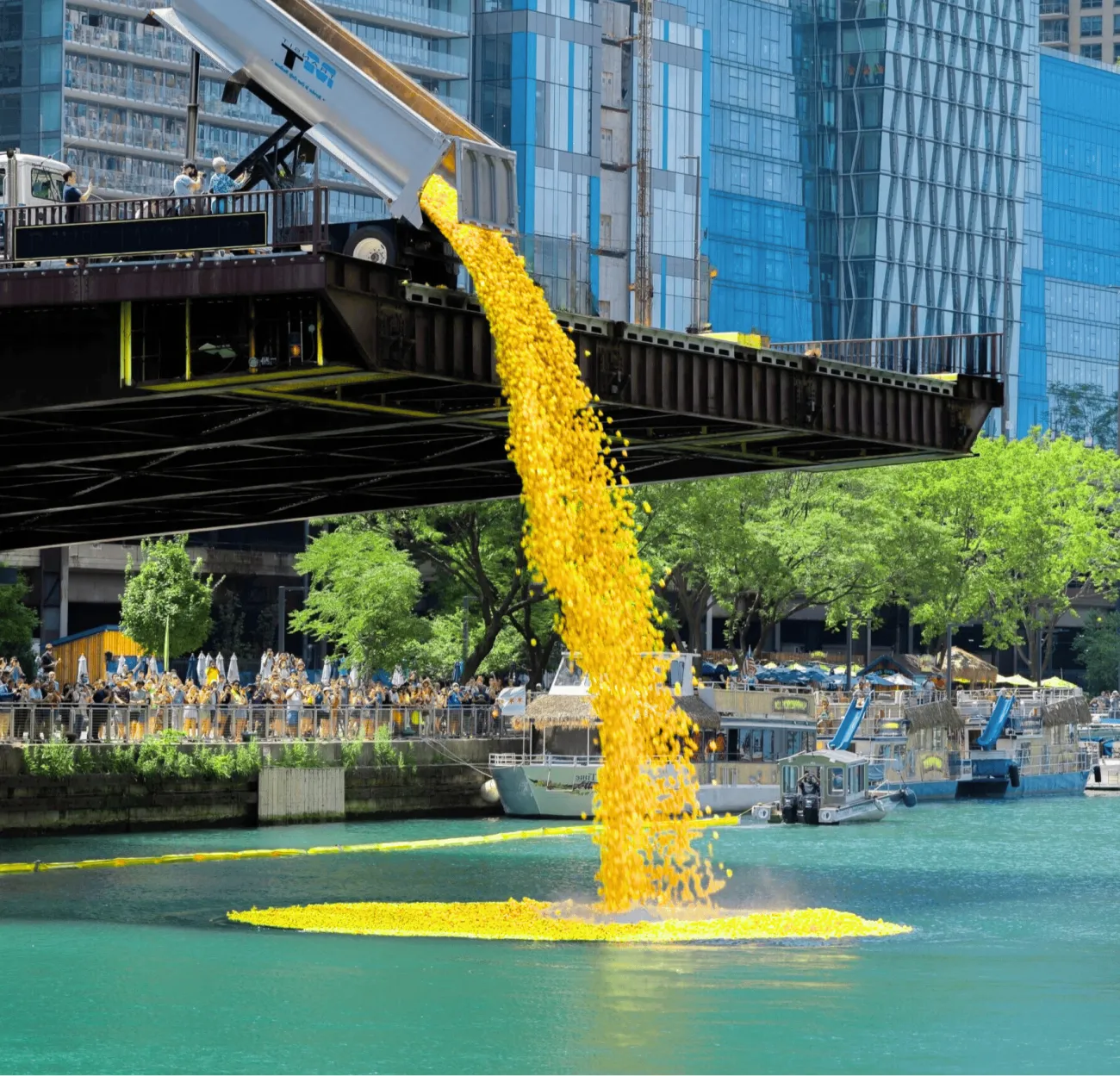
A committee of eight to twelve is the working number for a first race, plus a bigger crew for the week before and for race day, when ten thousand ducks have to be counted, bagged, and carried down to the water. The work concentrates instead of spreading across months of solicitation. Most of it lands in two bursts: the sponsor push at the start, the event at the end.
Ask Main Street for something else
If you’re already running a gala or a tournament, add the auction. It’s the cheapest revenue in a room you’ve already paid for. But if you’re staring down a fourth procurement season, and the same six businesses on Main Street have started recognizing your number, the thing worth changing isn’t your item count or your minimum bids. It’s what you’re asking those businesses for.
There’s a question buried under this that no auction committee ever puts on the agenda. The salon owner has written you a $200 gift certificate four springs running. Every one of them sold for about $130, and she’s a small-business owner, so she knows exactly what they’re going for. What’s she going to say the year somebody finally asks her for something else instead?