Duck Race vs. Cookie Dough Fundraiser: Which Raises More?
A product fundraiser returns a slice of each sale. Here's the cookie dough profit-share math against a duck race, and when the catalog still wins.
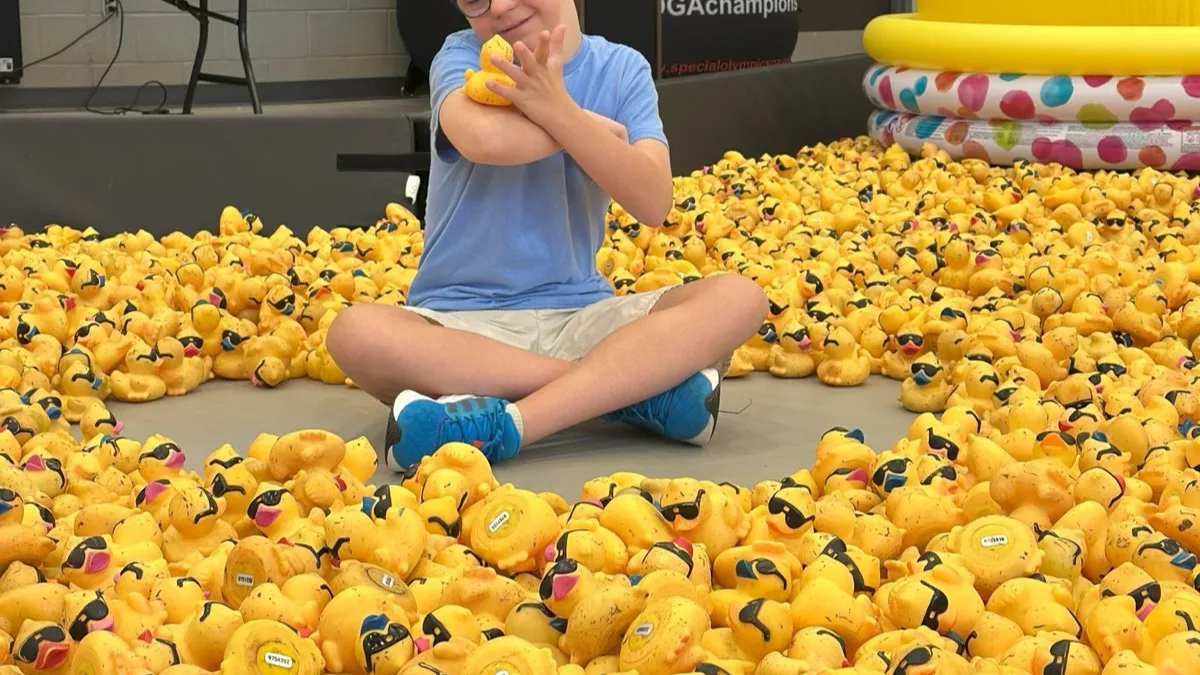
A tub of cookie dough costs a family $18. Somewhere between $7 and $9 of that typically reaches the school, and the rest goes to the company that printed the catalog.
Product fundraisers pay your organization a fixed share of every sale, commonly 40% to 50%, which leaves 50% to 60% with the company. A duck race sends adoption revenue to you against a flat event cost, so your margin climbs as you sell more: $20,000 in adoptions against a package starting under $9,000 keeps about 55 cents on the dollar, and $60,000 against that same flat cost keeps about 85 cents.
What share of a cookie dough or catalog fundraiser do you keep?
Commonly 40% to 50%, and the share you actually end up with is usually below the one on the brochure. Put the other way around, the company keeps 50% to 60% of what your families spend.
Several things erode your half from there, and none of them are hidden exactly, they’re just easy to skip past in the contract: prize and incentive programs charged back against your share, shipping, damaged or undelivered product, order forms that never come back with the money, and sales tax handling that varies by state.
Run the arithmetic on one item. A family pays $18 for a tub of cookie dough. At a 40% share, $7.20 goes to the school and $10.80 goes to the company. To net $20,000 you have to move about 2,800 tubs, because $20,000 divided by $7.20 is 2,778. If 300 families participate, that’s roughly nine tubs each, sold to nine different people who each said yes.
None of this makes product fundraisers bad. It makes them a known quantity with a ceiling written into the contract.
How do the two compare on a $20,000 goal?
Hold the goal constant at $20,000 net and see what each path costs your community to get there:
| To net $20,000 | Product fundraiser at 40% | Duck race |
|---|---|---|
| Your community has to spend | $50,000 | $29,000 |
| The unit | About 2,800 items at $18 | 5,800 ducks at $5 |
| People needed | As many buyers as you can find | About 580 supporters at the $50 average |
| Who does the asking | Students, parents, coworkers | The organization, by link, plus sponsors |
| Upfront cost | Usually $0 | Flat package, committed before you start |
| Margin if you double the volume | Still 40% | About 84% |
| What the supporter gets | A product they wanted | A numbered duck, prize odds, a free event |
| Sponsor revenue | None | A full sponsorship program |
| Year three | Participation tends to fade | Typically grows |
Check the two headline figures. $50,000 in sales at a 40% share is $20,000. On the other side, $29,000 in adoptions minus a $9,000 flat cost is also $20,000. Same result for your organization, and your community spent $21,000 less to produce it.
Why does a duck race’s margin improve while a catalog’s can’t?
Because one cost is a percentage and the other is a number.
Profit shares are written into the contract. Sell twice as much and you keep 40% of twice as much, which is more money at exactly the same rate. Nothing you do makes the split better. A duck race’s cost is set before you start and then stays put, so every additional adoption is close to pure net:
| Adoptions sold | Fixed event cost | Net | Margin |
|---|---|---|---|
| $15,000 | $9,000 | $6,000 | 40% |
| $30,000 | $9,000 | $21,000 | 70% |
| $60,000 | $9,000 | $51,000 | 85% |
Notice the first row. At $15,000 in adoptions, the duck race and the 40% product fundraiser land in exactly the same place. Everything above that line, the race pulls away. Everything below it, the catalog wins.
That break-even is roughly 300 supporters at the $50 average adoption. Hold it against your own community before you sign anything. Most partners also line up local sponsors to underwrite the event cost, which pushes the break-even lower, but don’t count on it until you’ve asked. What the event costs and what’s included is worth reading alongside your own community-size estimate.
Who does the selling, and what does that cost you?
Distributing the ask across your families is efficient on paper and complicated in practice. It shows up two ways.
The first is a kid with an order form on a stranger’s porch. Plenty of districts now restrict door-to-door sales outright, and most parents are uneasy about it regardless of policy. The second, and far more common, is the parent who takes the form to work and hits up the same twelve coworkers for the fourth year running, in an office that also has a Girl Scout, a soccer team, and two other schools represented.
Neither version is a moral failure. It’s the distribution model doing what it does. You’re borrowing your families’ social capital one household at a time, and you’re spending it at 40 cents on the dollar.
Duck races put the asking back on the organization. You share one link with your board, your donor list, your local press, and your sponsors’ employee networks. Kids still participate, and they participate in the part they like: they adopt a duck, they name it, they stand on the bank and yell at a river. Nobody’s nine-year-old is knocking on doors.
What does the supporter actually get?
With a product fundraiser, they get a thing, and that’s a real advantage. Some people will never make a donation but will happily buy cookie dough, because the transaction feels square. You’re not asking for charity, you’re selling something at a fair price. That converts a category of person a duck race sometimes doesn’t.
A duck adoption trades tangible for experiential. Five dollars buys a numbered duck, real odds at a prize, and an invitation to a free community event where a few thousand rubber ducks come down a river at once. Different value, and a much lower entry point than almost any product in a catalog, which is why the participation base ends up wider.
There’s a data difference too. Cookie dough buyers belong to the company’s order system. Duck adopters land in your database with an email address and a first gift, which makes next year’s ask meaningfully easier.
What happens in year three?
Product fundraisers tend to flatten and duck races tend to grow, and the mechanism is worth understanding.
Catalog fatigue is real and it’s arithmetic, not attitude. Same catalog, same families, same twelve coworkers. Participation slides a little each year. Because the margin is locked at 40%, net slides right along with gross, and there’s nothing in the model that compounds. Year three of a wrapping paper sale is year one with fewer people.
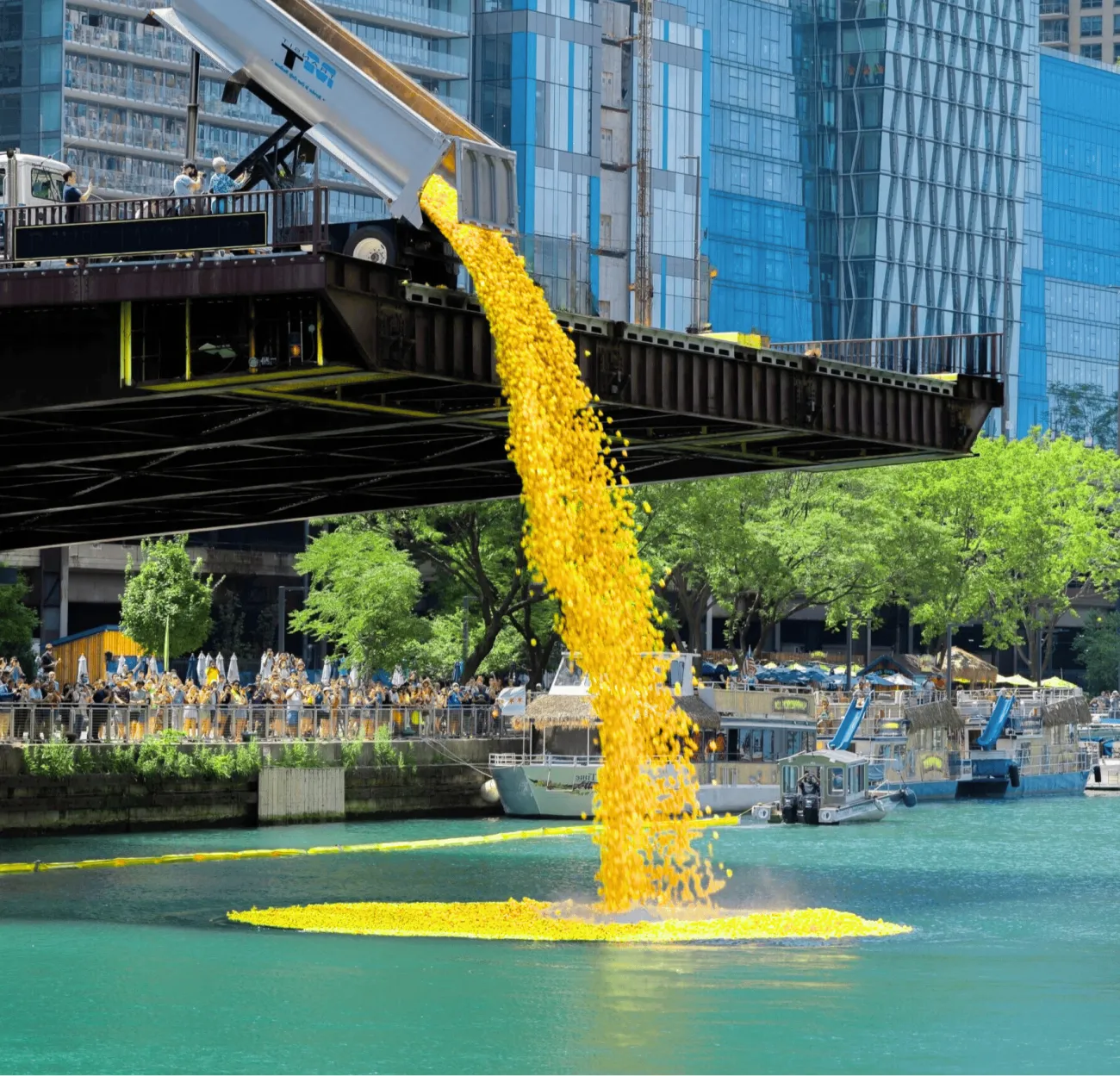
Duck races accumulate. A typical first-year Derby Duck Races event grosses $20,000 or more and grows from there, and the reasons are mundane rather than magical. The date lands on the town calendar. Sponsors renew and often move up a tier. Last year’s adopters are an email list you already own. Local press covers year two more easily than year one because there are photos now. Try getting a photographer out for a wrapping paper order form.
The sponsorship piece is the part most schools underestimate. The orthodontist on Main Street is not buying a logo spot on a cookie dough order form. A duck race gives you three to five sponsor tiers with real benefits, and those relationships tend to renew. Groups working through their options often compare this against everything else on the school fundraising menu or the booster club standbys.
When is a product fundraiser the better choice?
When you need a specific, modest amount of money soon, with no risk and no committee. That describes a lot of real situations.
- You need $3,000 for uniforms by October. A duck race is the wrong tool for a small, near-term number, because it wants 4 to 6 months of runway and a goal worth that runway.
- Risk is close to zero. In most order-taker programs you collect the money before the product ships, so you can’t lose.
- Any scale works. Forty families can run a product sale. So can four hundred. A duck race needs roughly 180 participating households at the $50 average just to cover a package under $9,000, and closer to 300 before it beats a 40% catalog.
- No date, no venue, no weather, no waterway, no permit. Nothing to cancel and nothing to reschedule.
- One parent with a spreadsheet can run it. No committee of twelve, no sponsor solicitation, no volunteer recruitment.
- The supporter goes home with something, which is the cleanest sale in fundraising and works on people who tune out donation appeals.
If you can’t picture 300 households in your community adopting ducks, or you can’t field a committee, or you need the money before Thanksgiving, run the product fundraiser. Plenty of booster clubs run both anyway, with a fall product sale and a spring race, just not within six weeks of each other.
What are the best alternatives to a product fundraiser?
The alternatives to a catalog product sale are a straight ask to your own families, a read-a-thon or fun run, a restaurant night, and a duck race. Any of them is worth a look before you sign another catalog contract, and the first one is the one nobody wants to try.
A straight ask keeps every dollar, because there’s no product in the middle and nobody’s taking a cut. One letter, one number, one deadline. It works better than most PTAs expect, and it stalls for a reason that has nothing to do with money: somebody has to be willing to send the email, and asking outright feels ruder than selling a tub of cookie dough, even though it’s plainly the kinder thing to do to your neighbors. A read-a-thon or fun run softens that by wrapping the ask around something the kids are doing anyway, which is why it’s usually the compromise a board can pass.
A restaurant night organizes in a week and hands you a modest slice of one evening’s tab. Treat it as a night out that happens to produce a check, and don’t put a line item on it. It’s a good way to keep a community warm and a bad way to fund anything.
That leaves the duck race, which asks for real money before it makes any and is the only one here whose margin gets better as the event gets bigger, because the package price stays flat while the adoptions don’t. If you can’t picture 300 households participating, that math doesn’t work yet. Our fundraiser comparison guide puts the profit shares next to each other.
Frequently asked questions
What percentage do product fundraisers actually pay out?
Most catalog, cookie dough, and gift-wrap programs quote 40% to 50%, and what you actually keep usually lands lower once prize programs, shipping, damaged product, and order forms that never came back are settled up. On an $18 item at a 40% share, your group keeps $7.20 and the company keeps $10.80. Ask the rep what a comparable school netted, not what the brochure promises.
How much does a school make on a cookie dough fundraiser?
It depends almost entirely on participation, since the rate is fixed. At a 40% share on $18 tubs, each sale returns about $7.20, so netting $20,000 takes roughly 2,800 tubs. With 300 participating families, that’s nine sales each, to nine different people who each said yes. Multiply your realistic participation by nine to see your actual ceiling before you commit.
Is a duck race worth it for a small school?
Not always, and the break-even is specific. A duck race carries a flat event cost, so it only beats a 40% product fundraiser above roughly $15,000 in adoptions, which is about 300 supporters at the $50 average. If your whole community is 120 families and there’s no wider circle to reach, the catalog is the safer call this year.
Do students have to sell anything in a duck race?
No. The organization does the asking through one shareable link, its donor list, local press, and sponsor networks. Students take part by adopting a duck, naming it something ridiculous, and yelling at it from the bank. That removes door-to-door selling entirely, which is why schools with policies against student solicitation can run a duck race without a waiver conversation.
How long does a duck race take to plan?
Plan on 4 to 6 months from first meeting to race day. The front of that window is sponsor solicitation, which ideally funds the event before the first duck is adopted. The middle is the online adoption push. The last stretch is prepping ducks and race-day logistics. Spring dates fill first, so the calendar is usually the real constraint.
What the aunt in Ohio ends up with
Predictability is worth real money when the goal is small and the deadline is close, and a catalog delivers it every time. What it can’t do is get better. A duck race asks for more upfront and returns a margin that improves every time the event grows, plus sponsors, an email list, and a date your town starts putting on the calendar.
Think for a second about the aunt in Ohio. She takes the call, she hears a nervous kid read off a script, and she says yes before he’s done, because she loves him. Six weeks later a box lands on her porch. Inside is a tub of frozen cookie dough she has nowhere to put and a candle in a scent that does not occur in nature. She wanted to help a boy she loves. What she got was a freezer problem and the small, familiar feeling of having been sold something.