School Fundraisers That Make the Most Money: 11 Ranked
Eleven school fundraisers ranked by profit per volunteer hour, with typical net, upfront cost, and whether kids have to sell door to door.
Most school fundraiser lists rank ideas by gross revenue, which is the wrong axis. The scarce resource in your building isn’t dollars. It’s the eleven parents who reliably show up.
Ranked by profit per volunteer hour, the most profitable school fundraisers are direct-ask donation drives, pledge-based fun runs, and restaurant nights. A no-frills direct ask nets around $14,000 on roughly 60 volunteer hours, about $230 an hour. Carnivals and book fairs sit at the bottom: a fall festival can burn 400 volunteer hours to net $6,000, about $15 an hour. Signature events raise far more in total dollars, but they cost far more hours.
Why rank school fundraisers by profit per volunteer hour?
Because volunteer hours are the one input a PTA can’t buy more of. Money you can raise. Parents who will answer the group text in March are finite, and you spend them whether you meant to or not.
Every school has the same small group doing everything. The treasurer who also runs the book fair. The two dads who set up tables at six in the morning. The parent who answers every email at 11pm and has now done it for four years. Burn that group out in October and your spring event has nobody to run it, which is a cost that never appears on any budget line.
Gross revenue hides all of it. A fall festival that grosses $14,000 looks great on a slide, right up until you count the 400 hours, the $4,000 in inflatable rentals, and the three volunteers who quietly don’t come back.
So run one calculation on every idea on your list: net dollars divided by total volunteer hours. Net, after the vendor’s cut, the rentals, the prizes, and the printing. It’s a blunt number. It also predicts, better than anything else, whether you’ll still have a functioning PTA in April.
Which school fundraisers make the most money per volunteer hour?
Direct-ask campaigns, pledge-based fun runs, and restaurant nights lead by a wide margin. Carnivals and book fairs trail badly. Product sales land right in the middle, which is the first hint that this axis is useful rather than final.
| # | Fundraiser | Typical net | Volunteer hours | Net per hour | Upfront cost | Kids sell door to door? | Repeatable? |
|---|---|---|---|---|---|---|---|
| 1 | Direct-ask “no-fuss” campaign | $8,000–$20,000 | 40–80 | ~$230 | Under $500 | No | Yes, with fading returns |
| 2 | Fun run or jog-a-thon | $10,000–$30,000 | 100–200 | ~$135 | $1,000–$4,000 | Pledges only | Yes |
| 3 | Restaurant / spirit night | $200–$800 per night | 3–6 | ~$110 | $0 | No | Monthly |
| 4 | Penny war | $1,000–$4,000 | 15–30 | ~$110 | Under $200 | No | Yes |
| 5 | Catalog / product sale | $4,000–$12,000 | 80–150 | ~$70 | $0 | Yes | Yes, fades fast |
| 6 | Silent or live auction | $10,000–$40,000 | 250–500 | ~$65 | $2,000–$10,000 | No | Yes, donor fatigue sets in |
| 7 | Cookie dough | $3,000–$8,000 | 60–120 | ~$60 | $0 | Yes | Yes, fades fast |
| 8 | Spirit wear | $1,000–$5,000 | 40–80 | ~$50 | Inventory risk | No | Yes |
| 9 | Duck race | $20,000+ gross year one, less a flat package starting under $9,000 | 150–400 | ~$40 | The package, often sponsor-offset | No | Yes, and the gross grows while the package doesn’t |
| 10 | Book fair | $1,500–$5,000 | 80–150 | ~$28 | $0, consignment | No | Twice a year |
| 11 | Carnival or fall festival | $3,000–$8,000 | 300–500 | ~$15 | $3,000–$8,000 | No | Yes |
Every figure is a typical range for a school of roughly 300 to 600 students, not a promise. The net-per-hour column divides the midpoint of each net range by the midpoint of each hours range. Redo it with your own numbers. The method matters more than our ranges do.
One row is shaped differently on purpose. The duck race is the only entry whose cost is a flat vendor package instead of a percentage split, so quoting a tidy net beside ten percentage-based competitors would flatter it, and we sell duck races. So: $20,000 or more gross in a typical first year, less a package starting under $9,000, is about $11,000. Over 150 to 400 hours that’s the $40. It puts our own product ninth of eleven.
The spread is stark. A direct ask netting $14,000 on 60 hours is worth about $233 an hour, and a fall festival netting $6,000 on 400 hours is worth $15. Same building, same parents, fifteen times the return.
Why is the direct ask so hard to beat?
Because it has almost no cost structure. A letter, a QR code, a deadline, and a thermometer graphic in the newsletter. No vendor keeps half, no rental truck shows up, nobody spends a Saturday running a ring toss. When a school sends a clear “skip the catalog, just give us $50” ask, nearly all of that $50 lands in the account. On pure efficiency, nothing on this list beats it.
Two things it doesn’t do, though.
It doesn’t acquire anybody. A direct ask only works on families already on your list and already bought in, so it grows your total exactly as fast as your enrollment does, which is to say not at all.
And it gets harder every year. A direct ask spends community trust without putting any back. Year one it feels refreshing. By year four it reads as another bill from the school, arriving between the yearbook invoice and the field trip form. Schools that lean on it alone tend to watch participation slide while the average gift from a shrinking core creeps up, which looks fine on the spreadsheet until that core’s kids age into middle school and take their checkbooks with them.
Efficiency is not the same thing as durability. You want both, which is why most schools that hit their number run a clean direct ask and one real community event.
Where does profit per hour mislead you?
In four places: low ceilings, fundraisers whose real product isn’t money, fundraisers that only look efficient because a child did the selling, and costs front-loaded into year one.
Restaurant nights score beautifully per hour and cap out around a few hundred dollars. Six hours for $600 is a terrific ratio and a rounding error against a $40,000 playground goal. Nobody has ever restaurant-nighted their way to new playground equipment.
Carnivals rank dead last here, and plenty of schools should still run one. A fall festival’s real product is a community that likes each other, which pays out later in volunteers, room-parent sign-ups, and how many families open the direct-ask email at all. Just don’t carry it in the budget as a revenue line. If you want the festival and the revenue, pair it with a headline event rather than asking it to be one.
Penny wars are the same shape. Two thousand dollars and a week of hallway chaos that kids talk about all year.
Then there’s the catalog problem. Catalog and cookie dough rank fifth and seventh here, ahead of a first-year duck race, and by the stated math that’s correct. It’s also an artifact. One adult signs a vendor contract and a hundred and forty kids do the selling, and a child’s Saturday has never once appeared in a volunteer-hours column. Add those hours and both rows fall through the floor.
Our own product sits ninth for the fourth reason. A duck race pays its entire vendor cost in year one, and that package doesn’t grow when the race does. Run it again with a bigger flock and the same hours divide a much bigger number.
Read the ranking as an allocation tool, not a verdict. For the same columns applied across every fundraiser type, not just school ones, our fundraiser comparison guide runs the wider version.
What makes a duck race work for a school?
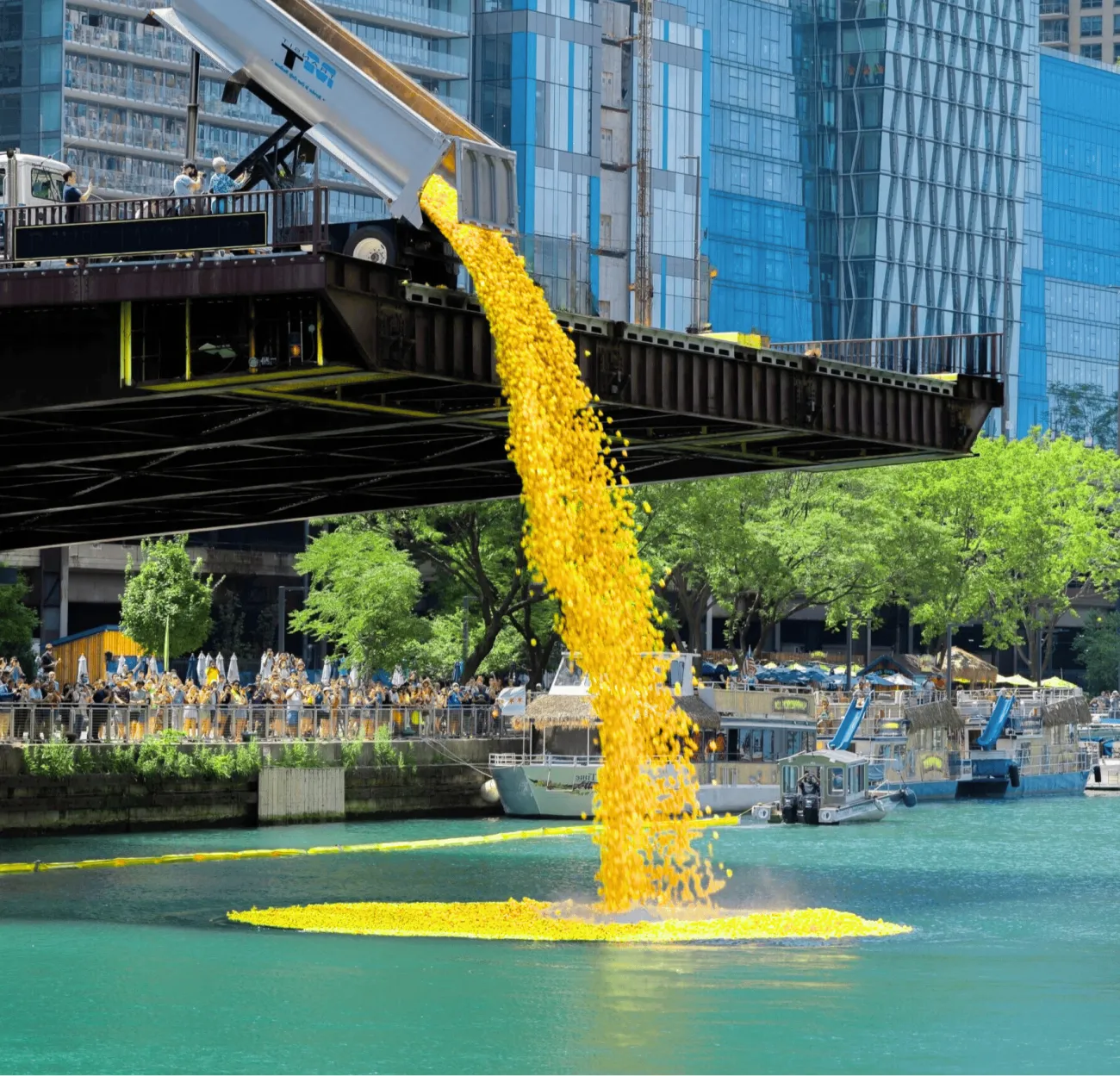
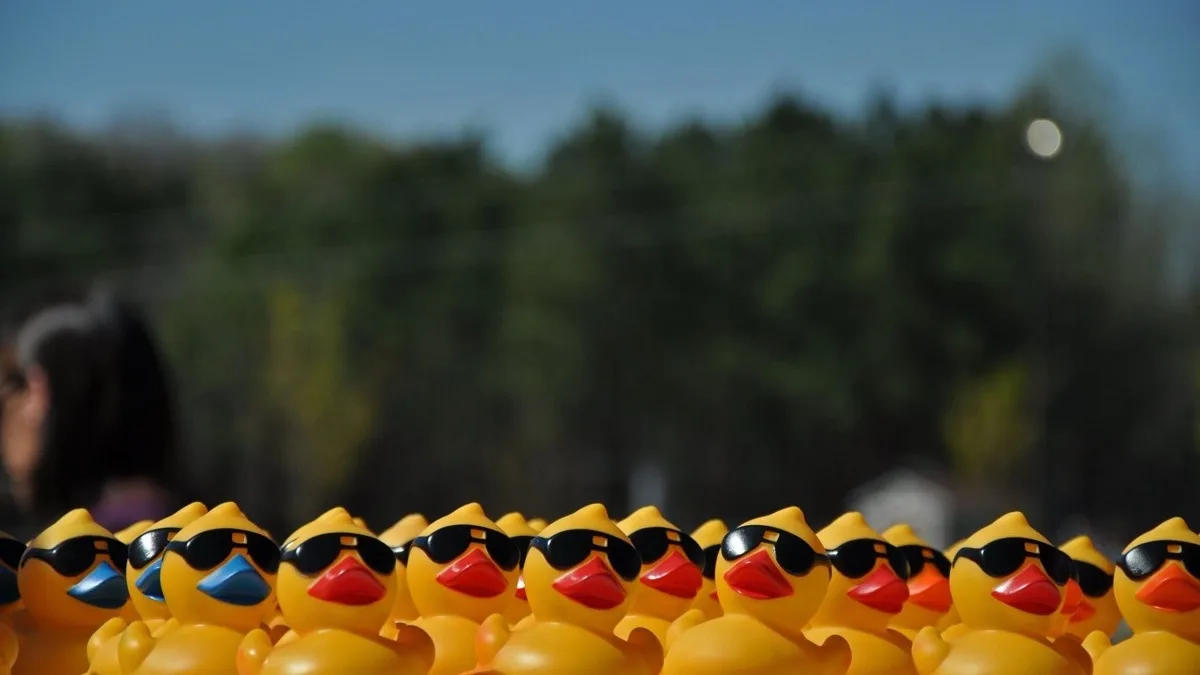
A duck race works for schools because the ask is small, kids can participate without knocking on a single door, and the ceiling is high enough to fund something families can point at. Families adopt numbered rubber ducks online, typically $5 each. On race day every duck goes in at once, and the first one across the line wins. Here’s how a duck race runs, start to finish.
What it isn’t is cheap in hours. Budget roughly 150 to 400 volunteer hours depending on race size, which is exactly why it sits ninth above. Anybody selling you a signature event as a low-effort revenue line is selling you something.
People don’t adopt one duck. Across our race platform in 2025, the average adoption transaction was $50, about ten ducks per supporter. So the question isn’t “can we possibly sell 5,000 ducks.” It’s “can we find 500 families,” which is a completely different conversation to have with your principal.
Scale it to your school and it stops being abstract:
- 200 participating families × $50 = $10,000
- 300 families × $50 = $15,000
- 500 families × $50 = $25,000
Grandparents, alumni, and neighbors push those totals up, because they can adopt from anywhere and they don’t count against your enrollment.
Sponsorship is the other half, and it decides whether you net well. Local businesses buy visibility in front of a family crowd, and when sponsors cover the package before adoptions open, that $11,000 starts climbing back toward the $20,000. Set against a catalog or product fundraiser, where a fourth grader hauls a glossy catalog up and down his own street and half of every order stops at the vendor, that’s a structurally different deal. We break the revenue side down further in our guide to how much a duck race actually raises.
When should your PTA skip the duck race?
Skip it if you need the money in six weeks, if your community is under about 150 families, or if nobody on your board will own sponsorship.
Timing. Plan on 4 to 6 months of runway. A duck race is a signature spring event, not a patch for a hole due Friday. If it’s October and your shortfall is a November problem, run a direct ask and book three restaurant nights.
Size. Below roughly 150 families the math gets thin. 120 families at the $50 average is $6,000, which is real money and probably not worth building an entire signature event around. Small schools usually do better with a fun run plus a direct ask.
Sponsorship ownership. If nobody will make the dozen phone calls to local businesses, don’t start. The race will still happen and still be fun, and you’ll have given away the part that pays for it.
One more. If your school already has a beloved twenty-year fall festival, don’t replace it. Add the duck drop to festival day and let the carnival keep being the party.
How do you build a fundraising year that doesn’t burn people out?
Pick one headline event, one direct ask, and a few near-zero-effort recurring items. Then stop adding things.
The failure pattern is five medium events. Catalog in September, festival in October, cookie dough in November, auction in February, fun run in April. Each grosses a few thousand, each eats a Saturday, and by March the sign-up sheet has the same four names on every line.
A calendar that holds up looks more like this:
- One signature event in the spring carrying most of the goal
- One short, specific direct ask in the fall, tied to a named thing families can picture
- Restaurant nights monthly, run by one parent with a template email
- Spirit wear online only, no inventory, no boxes in anyone’s garage
Four things. Somewhere between 250 and 600 volunteer hours across the whole year, depending on which signature event you pick, and it routinely beats the five-event grind on total dollars. It also leaves you a bench of parents who’ll say yes again next fall. For filling in those smaller slots, our older roundup of school fundraising ideas is a decent shopping list.
Frequently asked questions
What is the most profitable fundraiser for a school?
By profit per volunteer hour, a direct-ask donation campaign wins: roughly $14,000 net on about 60 hours works out near $230 an hour. By total dollars, a signature spring event wins instead. School auctions typically net $10,000 to $40,000, large fun runs $10,000 to $30,000, and a first-year duck race grosses $20,000 or more before its package cost comes out. Most schools that hit their goal run one of each.
How much do PTAs actually keep from catalog and cookie dough sales?
Usually 40% to 50% of what families spend, so a $10,000 catalog sale drops $4,000 to $5,000 into the PTA account. The rest goes to the vendor, the product itself, and the prize program handing out laser pointers at the assembly. Get the net percentage in writing before you sign anything, not the gross projection printed across the flyer.
Do school fundraisers have to involve kids selling door to door?
No, and most of the options here don’t. Direct-ask campaigns, duck races, restaurant nights, penny wars, and book fairs need zero doorstep selling. Only catalog sales and cookie dough push kids into it, which is a big part of why participation in those programs slides a little every year.
How long does it take to plan a school duck race?
Plan on 4 to 6 months from decision to race day. That’s sponsor outreach, building and launching the adoption website, and eight to ten weeks of promotion to families. Schools that decide in the fall for a spring race have the easiest run at it, partly because a lot of local marketing budgets reset in January and there’s money to ask for.
Can a small school run a duck race?
Yes, at roughly 150 families and up. At the $50 average adoption we saw across our race platform in 2025, 150 participating families is about $7,500 before a single sponsor, and sponsorship usually adds a meaningful layer on top. Grandparents, alumni, and neighbors can adopt too. Below that, a fun run paired with a direct ask does more for you than a signature event will.
Rank it on the hours you have
Rank your options on the axis that’s genuinely scarce and the list gets short in a hurry. One headline event, one clean ask, a few low-effort repeats, and your volunteers still pick up the phone in April.
On the axis this page uses, the duck race finishes ninth of eleven. A direct-ask campaign returns roughly six times as much per volunteer hour. Those are the numbers.