How Do the Ducks Get In and Out of the Water at a Duck Race?
Who dumps the ducks, how they get numbered, how they're scooped out, and how they ship home: a duck race flock's trip from pallet to trap and back.
“But how are we going to get the ducks back?” comes up on a lot of our planning calls. Fair question. Thousands of ducks is a lot of ducks. Here’s the whole trip, start to finish.
The ducks arrive on pallets in blue totes, about 160 ducks each, and your volunteers tag every one at a tagging party about a week before race day. On race day volunteers dump the totes in (or the fire department does the drop), a trap at the finish crowns the winner, and a kayaker plus a couple of netters scoop up the rest. Then you rinse and repack, and we schedule the freight home.
How do the ducks arrive?
On pallets, in blue totes that one person can carry. Each tote holds about 160 ducks, and a pallet holds about 15 totes. Freight is covered both ways.
For a 5,000-duck race, that’s roughly two pallets, each about five feet tall. You’ll want a garage, a storage room, or a corner of a sponsor’s warehouse to keep them in until race day. If your delivery address doesn’t have a loading dock, ask about lift-gate delivery when you book, since lift-gate and residential deliveries can add a freight charge.
In our standard race timeline, ducks ship about seven weeks before race day. That leaves time to put test ducks in your water and see how the course behaves before it counts. Our guide to duck race water covers the test run.
How do the ducks get their numbers?
At a tagging party about a week before the race. A crew of 10 or more volunteers puts a numbered tag on every duck, and the tagging kit is built so they can finish in an afternoon.
Each number ties to its adopter in eQuack, the software behind your race site. A few things worth knowing:
- Tag every duck, even the unadopted ones. That way you can keep selling right up to the adoption cutoff without anyone scrambling for untagged ducks.
- Numbers go out after tagging. The receipt a supporter gets at checkout doesn’t carry a specific duck number. Most races send numbers out after the tagging party, or you can simply announce winners by name.
- Cash and check sales count too. Volunteers enter in-person sales into the race site so those adopters get numbers like everyone else.
How do the ducks get into the water?
Your crew brings the totes to the race site, stages them at the drop point, and on the countdown the ducks go in. Volunteers can dump the totes by hand, or the fire department can do the drop.
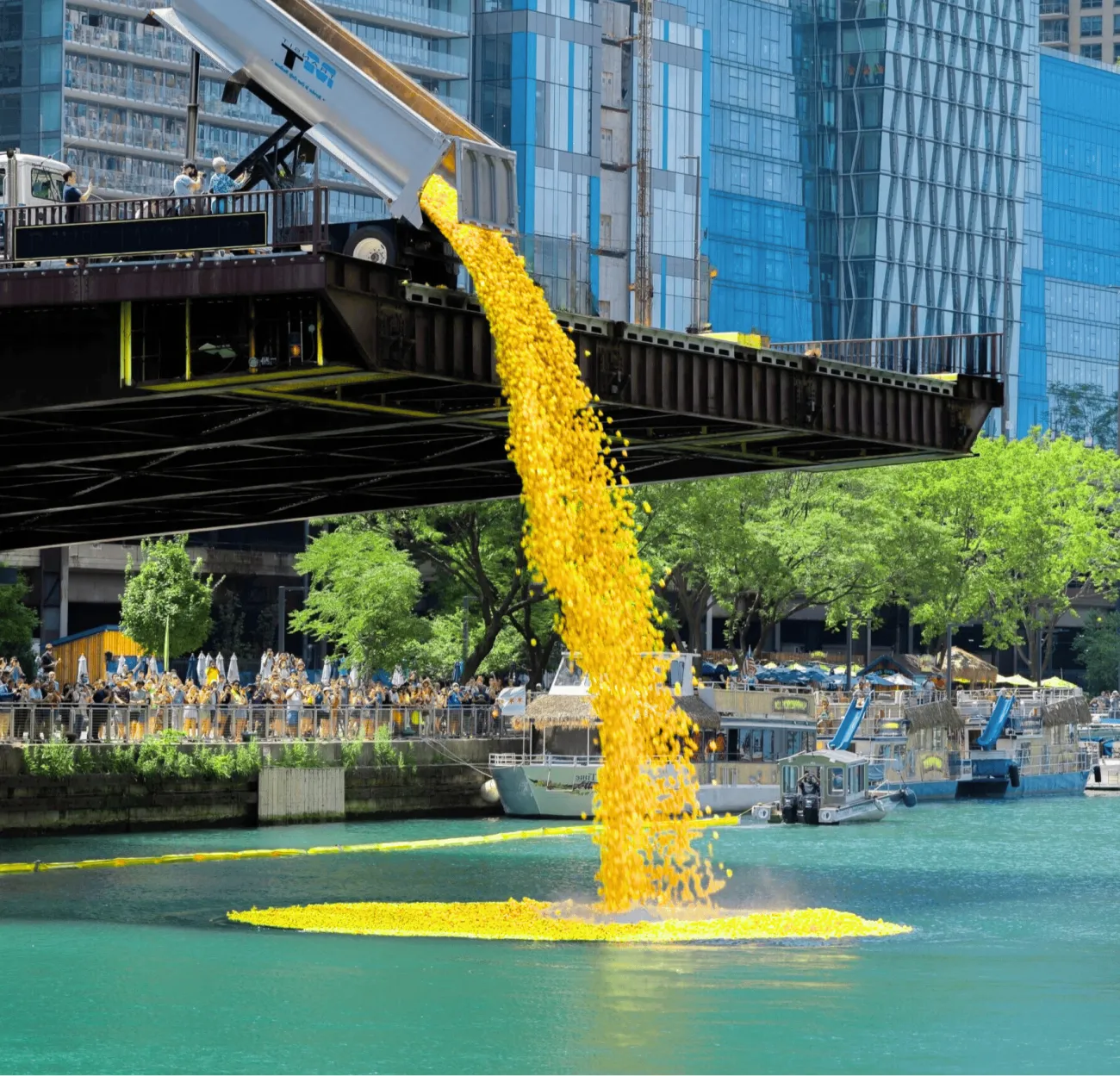
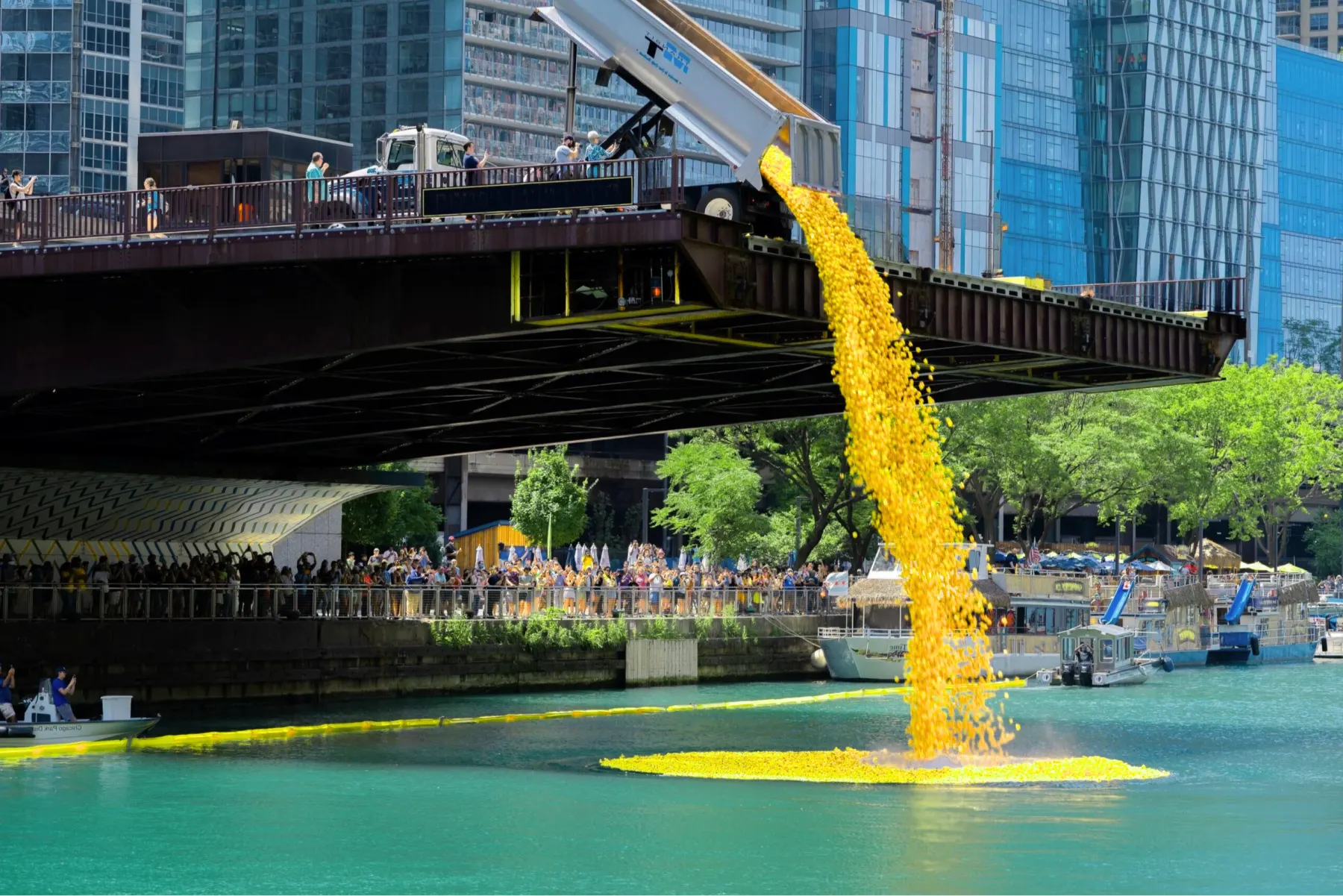
Big races go bigger. The Chicago Ducky Derby drops its flock off a bridge from a dump truck, which is why the photo at the top of this page looks the way it does. For a first race, a line of volunteers tipping totes off a dock or a bank works fine and makes a great photo. Just stage the ducks early. Counting them into whatever you’re dropping from always takes longer than first-timers expect, and our race day logistics guide builds that time into the schedule.
Who dumps the ducks: Derby Duck Races or your team?
Your team does. Nobody from Derby Duck Races is on site on race day, so the drop, the catch, and the cleanup belong to your crew, on a plan we build with you ahead of time.
A lot of first-time hosts picture the videos, with a truck or a front loader tipping thousands of ducks into a river, and assume that equipment shows up with the ducks. It doesn’t. The good news is that the drop is the easiest part of race day to hand to someone local:
- Your fire department. Some hosts ask the local fire department to do the drop, and in still water their hoses keep the flock moving. Crowds love it.
- An equipment sponsor. A local equipment rental or construction company with a front loader or an excavator can sponsor the drop itself. Their logo sits in the photo everyone shares, which is an easy sponsorship to sell.
- Your volunteers. A line of volunteers tipping totes off a dock or a bank works fine, especially for a first race.
Whoever does the drop, your safety plan for it is yours. We share what other hosts have done.
How is the winning duck caught?
A trap at the finish line that’s only one duck wide. Ducks come through one at a time, so the first number out is the winner, and the next numbers are second and third.
The trap comes with your ducks. Your crew pulls the first ducks through, reads the numbers, and checks them against the winners report before anyone announces anything. Verify first, announce second. Only adopted ducks can win, so if a duck with no adopter comes through, it’s skipped and the next one takes the spot. Our duck race prizes guide covers how many winners to plan for.
How do the ducks get back out of the water?
The lane keeps them together, and a small crew scoops them up. Usually that’s a volunteer or two in a kayak on the water and one or two people with nets on the bank.
Buoys, pool noodles, or lane dividers keep the flock in a channel from start to finish, so nothing drifts off where you can’t reach it. Once the winners are pulled, the crew herds the rest to the catch point and nets them into totes. Count them as they go back in, so you know the whole flock came home. Nothing gets left in the water.
What happens to the ducks after the race?
They go home to our warehouse and race again. Give them a quick rinse, pack them back in the totes, stack the totes on the pallets, and shrink-wrap them. We send the wrap, and we schedule the freight pickup, usually within a day or two of the race.
Return shipping is on us. The number stickers stay on, so there’s no peeling. The flock gets reused at the next race, which is why a duck that raced in one state in spring might race in another in the fall. Our guide to how many ducks you need explains why that beats buying and storing your own flock.
Why do all the ducks have to match?
Because a fair race needs identical racers. Every duck has to be the same spec, so the one that wins got there by luck and current, not because it was lighter or shaped differently.
That’s also why we don’t mix a host’s own ducks with ours in the same race. If you want custom colors or a different racer, like turtles, that’s a separate conversation, and the custom racers still have to match our racing spec.
Frequently asked questions
How are ducks put into the water at a duck race?
Volunteers carry the totes to the drop point and dump them in on the countdown, or the local fire department does the drop. Big races use a truck or a bridge. Whatever you drop from, stage the ducks early, because counting them into position takes longer than most first-time hosts expect.
How do they get the ducks out of the water?
A lane of buoys, pool noodles, or lane dividers keeps the flock contained. After the winners come through the one-duck-wide finish trap, a volunteer or two in a kayak herd the rest to the catch point, and one or two people with nets scoop them into totes. Count them so you know every duck came out.
Does Derby Duck Races dump the ducks on race day?
No. Nobody from Derby Duck Races is on site. Your crew runs the drop on a plan we build with you, and some hosts hand it to the local fire department or to an equipment company that sponsors the drop and gets its logo in the photo. We ship the ducks, the tags, and the finish-line trap, and we pay for the freight home.
How much space do 5,000 rubber ducks take up?
About two pallets of blue totes, each pallet roughly five feet tall. Each tote holds about 160 ducks, and one person can carry a tote. A garage or storage room works. If your address has no loading dock, ask about lift-gate delivery, since it can add a freight charge.
When do the ducks get their numbers?
At a tagging party about a week before race day, where 10 or more volunteers tag every duck in an afternoon. Tag all of them, even the unadopted ones, so you can keep selling until the cutoff. Each number ties to its adopter in the race software.
Who pays to ship the ducks back?
Derby Duck Races does. Freight is covered both ways. After the race you rinse the ducks, repack the totes, and shrink-wrap the pallets with wrap we send, and we schedule the pickup, usually within a day or two of the race.
Every duck comes home
From the pallet to the trap and back to the pallet, the whole trip is built so a volunteer crew can handle it. Your job is a tagging afternoon, a drop, a catch, and a rinse. The freight, the tags, the trap, and the wrap come from us.
Ready to see what your race would look like? Four quick questions get you a free race plan, and what the host does in a duck race covers the rest of your side of the work.