How Many Rubber Ducks Do You Need for a Duck Race?
Size your duck race from the revenue goal, not the duck count. At $5 a duck and a $50 average adoption, a 5,000-duck race needs about 500 people.
The duck count is the number everybody fixates on, and it’s the wrong place to start. Pick your revenue goal first and the ducks fall out of the arithmetic.
Work backward from your goal, not from a duck count. At $5 per duck, a $25,000 race is 5,000 ducks and a $50,000 race is 10,000. Then divide by ten. The average adoption on our race platform in 2025 was $50, or roughly ten ducks per supporter, so a 5,000-duck race needs about 500 people, not 5,000.
How do you calculate how many ducks you need?
Two operations. Divide your goal by $5, then divide that answer by ten.
Duck adoptions are almost always priced at $5, which makes the first step trivial. A $30,000 goal is 6,000 ducks. A $75,000 goal is 15,000. Nothing about that figure should rattle you yet, because it isn’t a headcount. It’s an inventory number, and inventory is the easy part.
The second step is what changes how the goal feels. Across our race platform in 2025, the average adoption transaction was $50. Nobody adopts one duck. They take six for the family, then two more in a coworker’s name, then another handful because their kid wants one for the dog. Ten ducks per supporter is the working ratio.
Run it through: 6,000 ducks is about 600 supporters. 15,000 ducks is about 1,500.
Put both numbers in front of your board. The duck count sells the event. The people count is what proves it’s achievable.
What size race should we aim for?
Match the goal to the community you can actually reach, then let the duck count follow.
| Revenue goal | Ducks at $5 | Supporters at the $50 average | The kind of community that carries it |
|---|---|---|---|
| $10,000 | 2,000 | ~200 | One school, one parish, or a service club with an active roster |
| $25,000 | 5,000 | ~500 | A mid-size congregation, a full PTA directory, a well-connected civic club |
| $50,000 | 10,000 | ~1,000 | A town of a few thousand, or a countywide nonprofit with a real donor list |
| $100,000 | 20,000 | ~2,000 | A small city with local media pickup and a few years of event history |
| $250,000 | 50,000 | ~5,000 | A metro signature event with corporate sponsors and a long track record |
Both middle columns are pure arithmetic. Drop your own goal in and the table behaves the same way.
That last column is judgment, not math, and it’s where most sizing conversations end up. A 400-family school can reach 200 supporters without breaking a sweat. Reaching 2,000 takes local news, a sponsor roster, and people who’ve done this before. Most first-time hosts belong one row below the row they want.
How many ducks should a first-year race plan for?
Fewer than you want. Size year one from the supporters you can actually name, not from what other races raised. First-year results vary too much with town size, sponsors, and teams for any single number to be a safe floor.
Here’s an example scenario, not a typical result: a host who can realistically reach about 400 supporters, at the $50 average, is looking at roughly $20,000 gross, or 4,000 ducks at $5. Swap in your own supporter count and the math works the same way. Gross is before prizes, fees, and local costs.
Sizing conservatively in year one costs you almost nothing and protects a lot. If you plan for 5,000 and your community surprises you, that’s a great problem and an easy conversation. If you plan for 20,000 because a board member got excited, you spend the whole spring chasing a number that was never grounded in your list size, and the volunteers who worked hardest end up feeling like they failed at a race that raised real money.
There’s also a compounding argument. Duck races grow year over year because the photos, the winners, and the sponsor logos from year one become the marketing for year two. A modest, well-run first race is a better platform than an oversized one that limped. We walk through the whole ramp in our guide to how much a duck race can raise.
Does it matter if you don’t adopt out every duck?
No. Your revenue is the number of ducks adopted times $5, and unadopted ducks simply don’t add to that total. They don’t subtract from it either.
This is a genuine structural difference from a product fundraiser. Four hundred unsold candy bars are money you already spent, sitting in a closet, quietly expiring. An unadopted rubber duck is just a duck that didn’t have a name on it this year, and it’ll be in the water again next spring.
Official race rules almost always make only adopted ducks eligible to win, so how many ducks physically go in the water is a logistics and photography decision rather than a revenue one. Some hosts float the full flock because a packed channel makes far better pictures. Others drop only the adopted birds. Ask your race coordinator which fits your waterway and your retrieval plan.
Should you buy your own ducks or use ducks that come with a package?
For nearly every first-time host, the ducks should come with the race. Buying your own flock is the single most common and most avoidable over-spend in this whole event.
Consider what “10,000 ducks” means as a physical object. It’s pallets. It’s a storage unit, or a corner of a sponsor’s warehouse that you now owe a favor for. It’s cash out the door before a single adoption comes in, cleaning between events, replacement of the ones that crack, and a permanent inventory decision made in year one about a race whose real size you won’t know for three years.
Line the two options up side by side and the pattern is hard to miss.
| What a race actually needs | If you own your flock | If it comes with a package |
|---|---|---|
| The ducks | Cash out before a single adoption comes in | Included, sized to the tier |
| Storage between races | Pallets, year-round, in somebody’s garage | Not your problem |
| Cleaning, sorting, replacing cracked ducks | Your volunteers, every season | Handled |
| Numbered tagging system | Source and buy it separately | Included |
| Adoption website and payment software | Build it or license it yourself | Included |
| Sponsor materials and print | Design and print on your own | Included |
| Growing from 5,000 ducks to 12,000 | Buy 7,000 more and find somewhere to put them | Move up a tier |
Every expensive part of a duck race sits in the bottom six rows. The ducks are the line item everybody pictures and the one that matters least, and the flock scales with whichever tier you pick, which our full cost breakdown lays out in detail.
An organization that’s certain it’ll run the same race every year for a decade, has free storage, and has volunteer labor for cleaning and sorting can own its flock and amortize it. Some long-running races do exactly that, and it works. Just go in knowing you’re buying the least valuable component, and that you still have to source everything else, right down to the person who has done this two hundred times and can tell you where to put the finish line.
What happens to the ducks after the race?
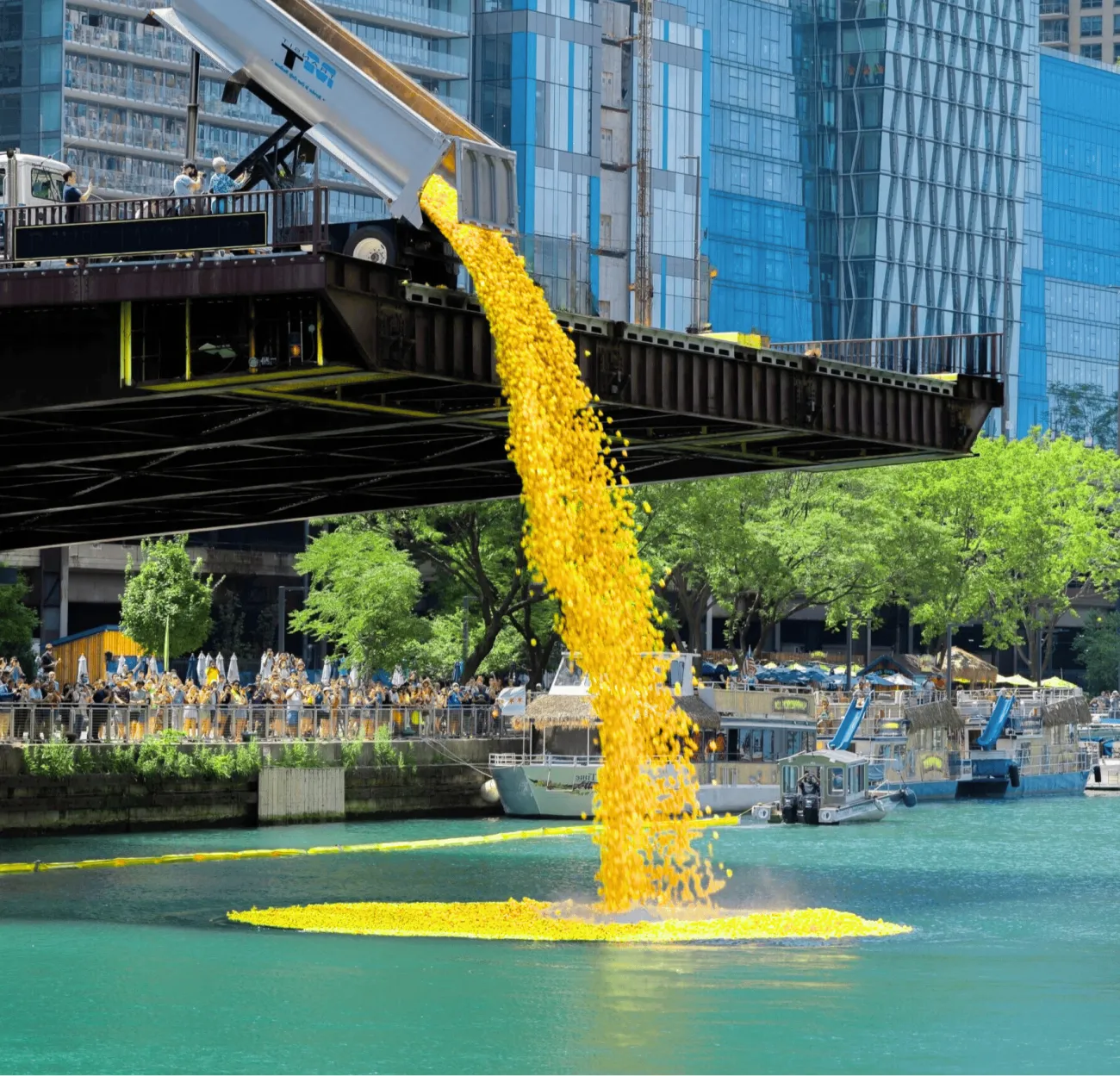
They’re collected and reused, every time. A boom or net across the channel corrals the flock at the finish, volunteers scoop them into bins, and the ducks get counted, rinsed, and stored for the next event. Nothing is left in the water. Nothing goes to a landfill. A duck that raced in Florida one March might well be racing in Iowa the next. Here’s the full trip from pallet to trap and back.
Retrieval is a real job, so staff it like one. Plan on a downstream catch point, six to ten volunteers who don’t mind getting wet, waders and long-handled nets, and a duck count at the end so you know the whole flock came home. Reconciling that count is also the thing waterway authorities ask about most, so put someone’s name next to it before race day rather than leaving it to whoever is still on the bank at the end.
When is a duck race the wrong size for your organization?
If your goal is under about $5,000, the numbers get thin. That’s 1,000 ducks and roughly 100 supporters, which is bake-sale money for event-sized paperwork. A duck race earns its keep at a scale where the flat production cost is a small fraction of what comes in, and below five figures that ratio stops working in your favor. At that size, the smaller-format options in our rundown of ten common fundraisers will serve you better.
Two other disqualifiers have nothing to do with size. If you have no volunteer crew and no sponsor relationships, duck count is not your problem and no package will fix it. And if race day is six weeks out, you’re already outside the runway. We recommend four to six months, and our planning timeline explains why that window matters more than the size of the flock.
Frequently asked questions
How many rubber ducks do you need for a duck race?
Enough to cover your revenue goal at $5 per duck. A $25,000 goal is 5,000 ducks, a $50,000 goal is 10,000, and a $100,000 goal is 20,000. For example, a $20,000 goal is 4,000 ducks, which at the $50 average is about 400 people. Your fundraising target and your community size set the count. The waterway doesn’t, and neither does any minimum order.
How many people do you need to adopt 10,000 ducks?
About 1,000. The average adoption on our race platform in 2025 was $50, roughly ten ducks per supporter, so 10,000 ducks divided by ten is 1,000 people. That’s a large congregation, a mid-size school community, or a service club with an engaged member list. You are not out looking for 10,000 individual buyers, which is the fear that stops most first-timers.
Is 5,000 ducks too many for a first-year race?
For most organizations, no. It’s a $25,000 gross and it needs roughly 500 supporters at the $50 average. If your list runs under a few hundred households and you have no sponsor commitments yet, start at 2,000 to 3,000 instead. Adding ducks in year two is a phone call. Explaining a shortfall to your board in year one is a whole spring.
Do you have to buy the rubber ducks yourself?
No. In a turnkey package the ducks come with the race, along with the numbered tagging, the adoption website, and the materials. Buying your own flock means cash up front, pallets stored year-round, and sourcing everything else separately. Organizations that have run the same race for a decade sometimes own their ducks. It’s rarely the right first-year call.
What happens to the ducks after the race?
They get collected, cleaned, and reused. Volunteers net the flock at the finish line, count it, and pack it for the next event, so nothing is left in the water and nothing goes to a landfill. Plan on six to ten people for retrieval and a final duck count. Waterway and parks authorities ask about this before they issue a permit, so have the answer ready.
How much does each rubber duck cost to adopt?
Duck adoptions are typically $5 each, and that price holds no matter how many a supporter takes. Ten ducks is $50, which is exactly where the average 2025 adoption landed. The price stays flat on purpose: a supporter deciding in fifteen seconds on a phone at a stoplight converts better than one doing arithmetic.
Size it for the list you have
Your committee will want to argue about the flock. Steer them to the supporter number instead, because that’s the one that decides whether any of this works, and it’s the one you can check against something real. Look at the figure the division gives you and ask whether you could email that many households tomorrow and expect them to open it.
If the answer is no, move the goal rather than the math. A 4,000-duck race that fills up is exactly why next spring’s committee gets to argue about 8,000.